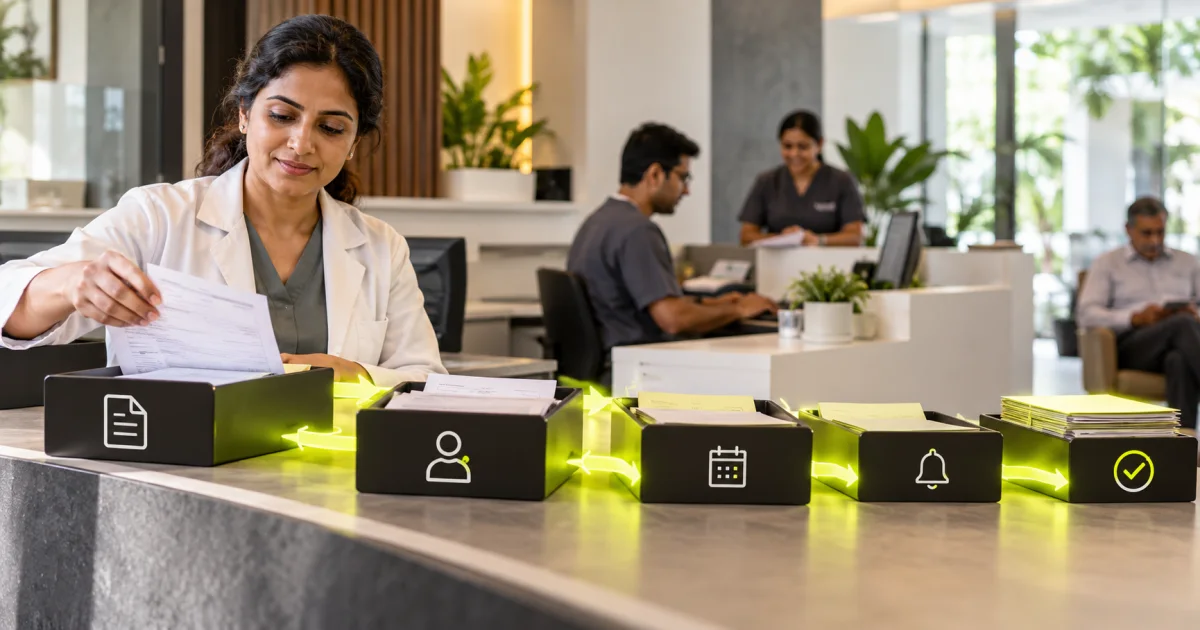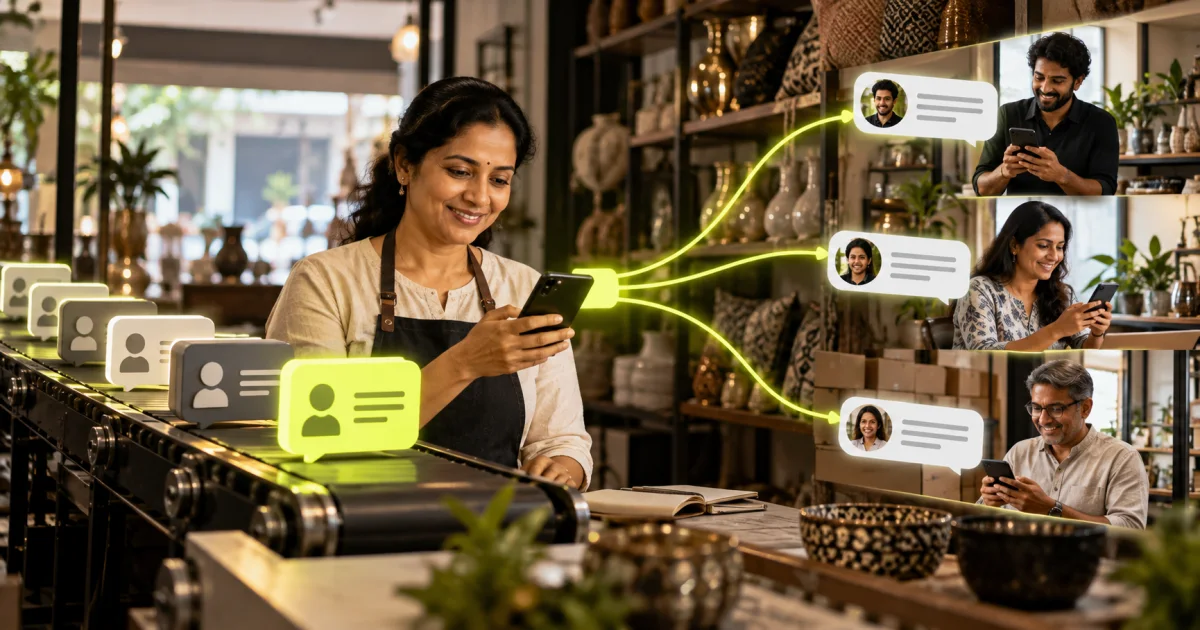
To automate lead follow-up, define the enquiry trigger, owner, message purpose and next action before connecting tools. Use relevant, permission-aware communications and stop or redirect the sequence when a customer replies or opts out. Keep the team responsible for context, exceptions and meaningful sales conversations.
Plenty of enquiries in India are lost in the gap between the form submission and the first reply. A lead fills your contact form at 9:40 pm, someone opens the inbox at 11 the next morning, and by then the buyer has spoken to two competitors who answered faster. That gap is the real reason owners ask us how to automate lead follow up. The answer starts with speed, not with clever copy.
Automation here does not mean a bot pretending to be a person. It means rules that acknowledge every enquiry in seconds, put a named human on it, and keep nudging until someone replies. Our team builds these flows as part of our automation services, and the same structure holds whether you handle twenty enquiries a month or two hundred.
Why the first few minutes decide the outcome
Speed to first response is one of the least expensive levers you own. It costs nothing in extra ad spend, needs no new landing page, and works on leads you have already paid for. Most owners skip it because it feels administrative rather than strategic.
Look at it from the buyer's side. They sent enquiries to three or four businesses in one sitting, usually from a Google search, a JustDial listing or an IndiaMART query. The first useful reply frames the conversation and sets the comparison. Everyone who answers later is arguing against an anchor that is already in place.
This matters most for enquiries from paid campaigns, where you spent money to create the click. A lead that goes cold in twelve hours cost you exactly the same as one that converts. Tightening response time is often one of the quickest ways to pull your cost per lead back down without touching a single bid.
What should an instant acknowledgement actually say?
It should confirm what was received, name the person handling it, and give a realistic time for the human reply. Add one useful detail the lead cannot get elsewhere, such as your working hours or a direct number. Skip the marketing paragraph. Four sentences maximum, sent within sixty seconds.
The useless version reads: thank you for contacting us, our team will get back to you shortly. It tells the lead nothing, commits to nothing, and signals that nobody is actually there.
The useful version does four things. It repeats what they asked about, so they know a real system received it. It names the person who will call, with a number that reaches that person. It states a window, such as before 6 pm today or first thing tomorrow, and your team keeps that promise.
Out-of-hours enquiries need their own version. Someone who writes at 11 pm should be told when the office opens and that they are first in the queue. Never send a message that implies a team is working when nobody is.
How to automate lead follow up without sounding scripted
The robotic tone is not caused by automation. It is caused by writing messages that could have been sent to anybody. Automated messages sound human when they carry specifics: the service asked about, the locality, the timeline the person typed into your form.
- Capture source and service on every lead record. A missed call from your Google Business Profile and a form fill from a pricing page deserve different opening lines.
- Write three or four message variants per service instead of one house template. Fifteen minutes of writing removes most of the machine feel.
- Insert real variables: first name, service, city, and the question they typed. Never insert a variable you cannot guarantee is filled.
- Send from a named person, not from a support alias. Named senders get replies.
- Keep every automated message under sixty words. Long automated messages read as broadcasts and get ignored.
- Build the stop condition first. The moment a lead replies on any channel, every queued message for that lead cancels.
That last rule is where most setups quietly fail. A lead replies on WhatsApp, and two days later the email sequence sends a cheerful note asking whether they saw the earlier message. It destroys the credibility the first reply earned. Decide the exit before you build the sequence.
Who owns the lead once it lands?
One named person, chosen by a rule the system applies automatically. Round robin works when everyone sells the same thing. Territory or service type works better when skills differ. Whatever you pick, add a fallback: if the owner has not opened the lead within thirty minutes, it reassigns itself and alerts a manager.
Assignment has to happen in the same second the lead arrives. If it waits for a morning stand-up, the window has already closed. Push the lead to the owner's phone through WhatsApp or a mobile notification, with a one-tap link to call.
Record two timestamps on every lead: when it arrived, and when a human first responded. That single pair of fields will tell you more about sales performance than most dashboards. If you already run a structured system for managing enquiries, this is a report you can pull weekly with no extra tooling.
A follow-up cadence that stops when the lead replies
A cadence is a schedule with an exit. The pattern below suits most Indian service businesses with considered purchases: home services, clinics, manufacturing enquiries, professional firms. Adjust the timing to your sales cycle and keep the structure.
| Step | Timing | Channel | Purpose |
|---|---|---|---|
| 1 | Under 60 seconds | WhatsApp and email | Acknowledge the specific request, name the owner, state the reply window |
| 2 | Within 15 minutes, business hours only | Phone call | First human attempt, usually the step that moves the enquiry forward |
| 3 | Same day, early evening | Short recap plus one specific question that is easy to answer | |
| 4 | Day 3 | Scope, indicative budget band, and what happens next | |
| 5 | Day 7 | Call, then one WhatsApp message | Final attempt, then move the lead to a monthly nurture list |
Two rules keep this cadence safe. Every step cancels the moment the lead replies, books a call, or asks to be left alone. Nothing sends between 9 pm and 8 am, whatever your timezone logic says.
Before you switch a cadence on, confirm each of these:
- A reply on any channel stops every pending step for that lead.
- Opt-out instructions appear in the first automated message.
- Quiet hours are enforced, including Sundays and public holidays.
- Duplicate enquiries from the same number merge into one record.
- Failed sends alert a human instead of failing silently.
- Every message fits on one phone screen without scrolling.
Once it runs, the reporting matters more than the copy. Each week, check how many leads got a human response inside fifteen minutes and how many slipped past a full day. If you want that reviewed against your own numbers, talk to our team and bring one month of enquiry data.
WhatsApp, email or a phone call: which channel wins?
Use the channel the lead chose, then add exactly one more; WhatsApp suits speed and short answers. Email suits quotes, scope notes and anything a buyer forwards to a colleague. Phone suits qualification and larger decisions, where tone carries more than text. Three channels at once reads as pressure, not service.
WhatsApp is where a lot of Indian buyers prefer to reply, and the rules around it are strict. The WhatsApp Business Platform separates what you may send inside the 24 hour customer service window from what needs a template approved in advance. Getting this wrong hurts your quality rating, and a poor rating limits how much you can send at all.
- Collect explicit opt-in before any business-initiated message, and store where and when it was given.
- Ask for consent with an unticked checkbox rather than a pre-ticked one, and have your own advisor confirm what your consent wording needs to cover.
- Messages you start outside the 24 hour window must use approved templates.
- Once the lead replies, the free-form window opens. Use it for a real conversation, not a broadcast.
- Marketing templates need clearer consent than utility ones, and a user can block you in two taps.
- Keep opt-out simple, honour it across every channel, and log it against the record.
Email still earns its place for anything the buyer forwards internally: scope, timelines, GST details, comparison notes. The phone remains the fastest way to qualify a serious enquiry. We go deeper into the platform mechanics in our guide to automated messaging on WhatsApp.
Where the human has to take over
Automation buys you the first hour. It cannot handle the second conversation. The handover point is where most setups fail, because nobody wrote it down.
Route a lead to a person immediately when any of these appear: a price question on non-standard scope, a complaint, a competitor's quote, a technical requirement, or a message with any emotion in it. The salesperson needs the full thread visible before they respond. Automation should never be the thing that answers a frustrated customer, which is the clearest case where an automated chat window costs you business.
The practical fix is a shared record. Every automated message, reply and call outcome sits on one timeline the salesperson opens before dialling. This is where connecting your CRM properly earns its keep: not in sending more messages, but in making sure the human who calls already knows what happened.
We build these flows for service businesses across Pimpri-Chinchwad and Pune, and for Vadodara clients handled by the same Pune team. Flows and campaigns typically go live in two to four weeks, with weekly checkpoints while we tune the cadence against real reply rates.
Frequently asked questions
How fast should the first human reply be?
The automated acknowledgement should be instant. The human reply should land inside fifteen minutes during business hours, and in the first hour of the next working day for overnight enquiries. Speed beats polish here. A rough call in ten minutes outperforms a perfect email the next afternoon.
Will automated follow-up annoy my leads?
Only if it ignores their replies or arrives at odd hours. A short, specific, correctly timed message that names a real person reads as good service. Irritation comes from volume without relevance, so cap the sequence, enforce quiet hours, and stop everything the moment someone responds.
What tools do I need to start?
A CRM or a disciplined shared sheet, an automation layer such as n8n, Make or Zapier, and an approved WhatsApp Business sender. Tool pricing changes often, so check each vendor's own pricing page before committing. Most small teams can start with what they already pay for.
Can I run this without a CRM?
Yes, for a while. A shared sheet with source, owner, timestamps and status will run a basic cadence for a small team. You will outgrow it once two people work the same leads, or once you need reporting across a full quarter.
Start with your next twenty enquiries
You do not need a platform to fix this. Take your last twenty enquiries, write down when each arrived and when a human first replied, and the problem will name itself. Then automate the acknowledgement and the assignment. The cadence can wait until week two.
If you would rather have the whole flow designed, built and measured than assembled in pieces, send us the shape of your current process. Tell us how enquiries reach you today and we will map a follow-up cadence to your team's real capacity, with the stop rules and consent handling built in from the first day.