AI agents can search knowledge bases, update CRMs, generate content, call APIs and coordinate workflows. But when an agent makes a mistake, teams need more than a chat transcript to understand what happened.
Monitoring is one layer of a secure deployment. For the controls that should sit alongside it, from scoped credentials to approval gates, see our AI agent security checklist.
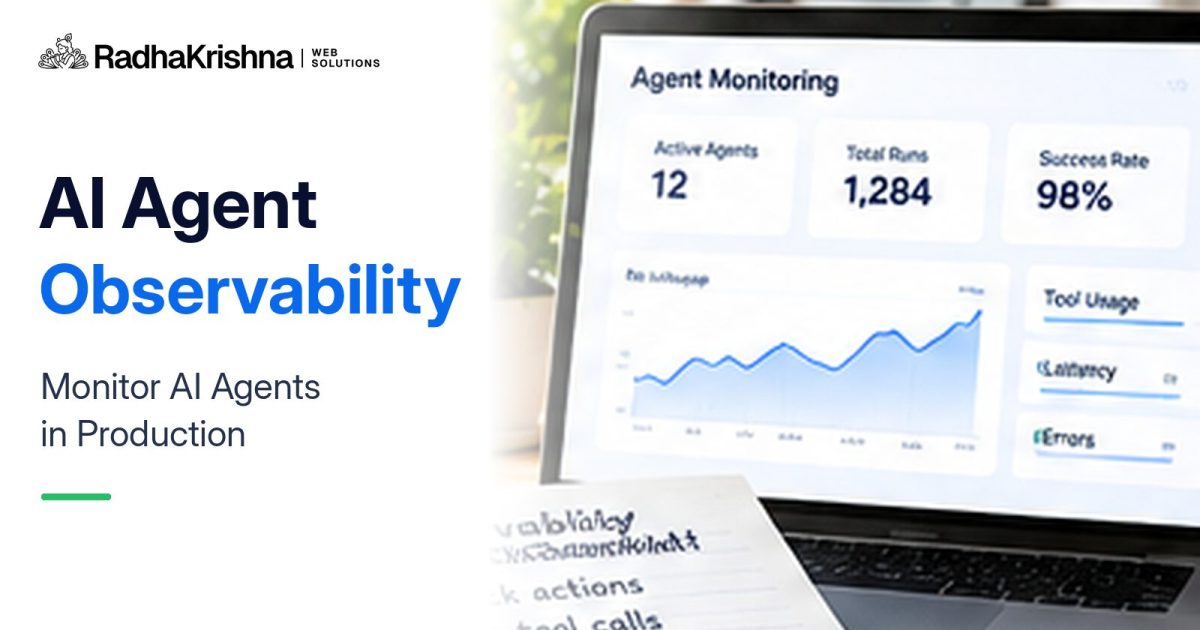
AI agent observability is the practice of monitoring agent decisions, tool calls, reliability, cost and outcomes so that teams can improve and safely operate AI workflows in production.
What is AI agent observability?
Observability helps engineers answer four practical questions: What did the agent attempt? Which information and tools did it use? Did the task succeed? And what did the execution cost?
Unlike a conventional API request, one agent task may involve several model calls, retrieval steps, retries and third-party actions. A single success or failure status cannot explain the complete workflow.
Why normal application logs are not enough
Traditional logs often record an endpoint, timestamp and response code. An agent workflow also needs a trace linking the initial user request to the steps that followed.
Consider an agent asked to prepare a customer follow-up: it searches the CRM, retrieves a conversation, drafts a message and requests approval. If it uses outdated CRM data, the email might be grammatically perfect but factually wrong. Tool-level traces make that failure easier to investigate.
Five signals every production team should track
1. End-to-end task success
Track whether the requested business outcome was achieved, not merely whether the model returned an answer. Define a clear success criterion for each workflow, such as an approved draft created or a report delivered with correct date filters.
2. Tool-call reliability
Record tool names, request identifiers, latency, success and error types. Distinguish authorization errors, validation failures, rate limits and infrastructure timeouts. Avoid storing sensitive raw payloads by default.
3. Latency and retries
Measure total task duration alongside time spent in model inference, retrieval and external APIs. Track retries separately because repeated calls can increase cost or create duplicate side effects.
4. Model and infrastructure cost
Measure token consumption, model charges and infrastructure expenses per completed task. Cost per successful outcome is generally more informative than cost per request.
5. Human corrections and safety events
Record how often reviewers reject drafts, edit outputs or stop an action. Track denied tool permissions and approval requests without treating every denied action as a defect.
A practical agent tracing example
A useful execution trace might contain the following sequence:
- Task received: create a weekly marketing performance summary.
- Permissions checked: read-only analytics access granted.
- Analytics tool called: date range validated and report returned.
- Model generated summary: claims linked to retrieved metrics.
- Quality checks completed: totals reconciled and missing data flagged.
- Draft delivered: reviewer accepted or requested corrections.
Each step should carry a trace ID so developers can investigate failures without guessing which events belong together.
What should go into an AI observability dashboard?
| Metric | Why it matters |
|---|---|
| Task completion rate | Shows useful end-to-end reliability |
| Human correction rate | Reveals quality and trust issues |
| Tool error rate | Identifies broken integrations |
| Median and p95 latency | Shows typical and slow user experiences |
| Cost per successful task | Connects spend to value |
| Approval and policy denials | Surfaces operational safety decisions |
Segment metrics by workflow, model version, tool version and environment. Otherwise a strong overall average can hide one unreliable business process.
Build privacy and security into telemetry
Agent traces may contain prompts, customer records, credentials or confidential documents. Minimize collected data, redact secrets, restrict trace access, set retention limits and avoid copying full user messages unless necessary and authorized.
Observability should support governance rather than create a second unprotected copy of sensitive business information. Read our guide to AI agent governance in production for the related permissions and approval controls.
How to add observability to an MCP-connected agent
When agents use Model Context Protocol (MCP) tools, instrument both the agent application and the underlying tool service. Log a shared correlation ID, tool identity, authorization result, validation errors and execution status. The MCP layer does not replace authorization checks in downstream systems.
For architecture context, see MCP vs API: how AI agents use integrations.
A phased implementation checklist
- Start with one workflow: define outcomes and a small baseline test set.
- Add structured tracing: connect model calls and tools with a trace ID.
- Measure quality: record completion, corrections and known failure categories.
- Set alerts: notify owners when failure rates, latency or cost exceed agreed thresholds.
- Run evaluations: replay representative safe test cases after prompt, tool or model updates.
- Review monthly: improve prompts, permissions, source data and tools based on actual failures.
Common mistakes to avoid
- Counting successful model responses as successful business tasks.
- Keeping only free-form text logs without trace IDs.
- Logging passwords, tokens or customer data unnecessarily.
- Ignoring duplicate actions caused by retries.
- Measuring average latency without slow-tail performance.
- Changing models without comparing results against a test set.
Final takeaway
AI agents become trustworthy when businesses can explain their actions and measure their results. Start small: trace one workflow, define success, review failures and expand only after the system demonstrates reliability.
For development teams exploring agent-assisted software workflows, our article on what developers will do with AI coding agents adds another perspective on supervision, validation and ownership.
Frequently asked questions
What is AI agent observability?
AI agent observability is the monitoring of agent workflows, model calls, tool interactions, costs, failures and business outcomes so teams can understand and improve production behavior.
What metrics matter most for AI agents?
End-to-end task success, human correction rate, tool errors, p95 latency, cost per successful task and permission or approval events are useful starting metrics.
How is agent tracing different from logging?
Tracing links the steps of one task across model calls and tools with a shared identifier, while logs capture individual events.