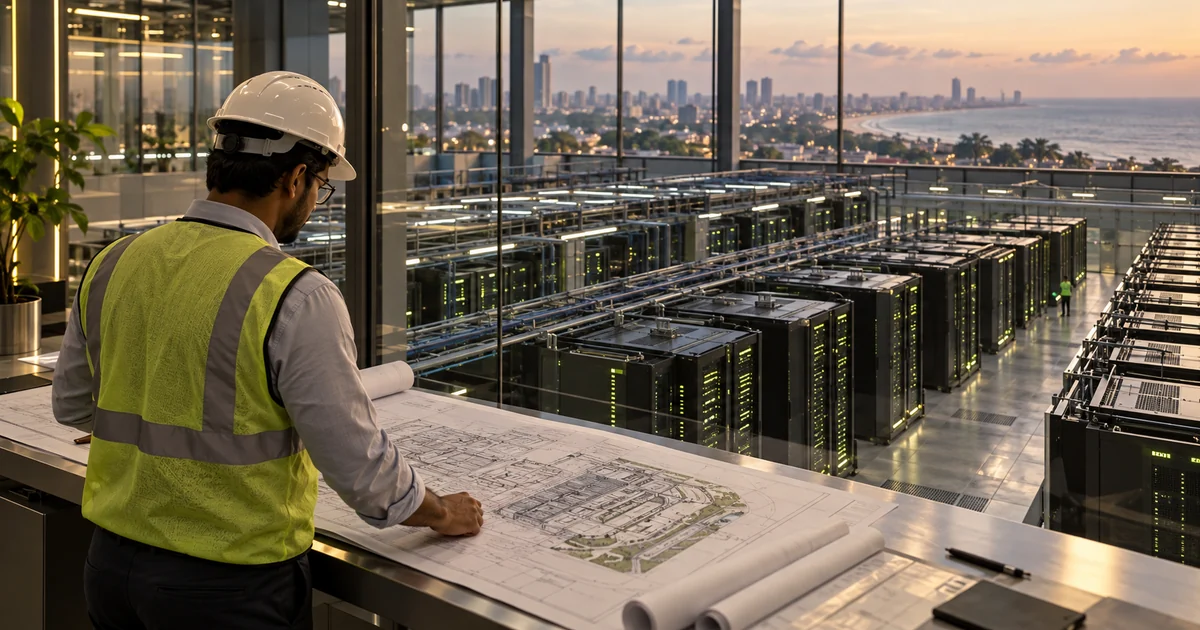
Vultr and AMD announced plans for a 20 MW AI supercluster in Chennai on 21 October 2026. The proposed deployment will initially use AMD Instinct MI355X GPUs and form part of Vultr's 34th global cloud data center region. It could expand in 2027, but the announcement should not be mistaken for confirmation that the full capacity is already live and generally available.
News date: 21 October 2026. Research verified: 24 October 2026. The main reference is Vultr's official Chennai data center announcement. This article separates vendor-announced plans from practical conclusions for Indian developers. No RKWS deployment or performance benchmark is implied.
What is the Vultr AMD Chennai AI supercluster?
An AI supercluster is a large computing environment that combines many high-performance accelerators with networking, storage, power and cooling so teams can run demanding model workloads. Vultr says the Chennai project will begin with 20 megawatts (MW) of AMD Instinct MI355X GPU infrastructure, supporting training, fine-tuning and inference.
The 20 MW figure describes an infrastructure-scale deployment plan. It should not be interpreted as a count of GPUs, a performance score, a guaranteed customer allocation or the amount of immediately purchasable capacity.
What did Vultr and AMD announce on 21 October 2026?
The vendor announcement outlines an initial GPU deployment in Chennai and a next phase in 2027, involving newer AMD hardware. Vultr described the project as among the world's largest AMD Instinct superclusters and called it India's largest planned AMD Instinct deployment. Those size characterisations are the company's statements, not independent measurements.
| Item | Announced detail | Important status |
|---|---|---|
| Location | Chennai, Tamil Nadu, India | Announced region and deployment |
| Vultr region | 34th global cloud data center region | Company-announced expansion |
| Initial power scale | 20 MW | Planned initial supercluster |
| Initial accelerator | AMD Instinct MI355X | Planned GPU infrastructure |
| 2027 expansion | AMD MI455X and Helios rack-scale solution | Future plan; subject to delivery |
| Target audience | AI labs, startups, enterprises, research groups | Intended market, not automatic service eligibility |
The proposed platform sits within a broader Vultr-AMD collaboration and the vendor's emphasis on open AI software and infrastructure choice. Details such as per-instance pricing, production SLAs and capacity reservations must be checked directly rather than inferred from an announcement.
Why does a Chennai AI supercluster matter for India?
Access to local infrastructure may help Indian companies build and operate AI services with lower network distance to domestic users and more control over where workloads run. But geography by itself does not guarantee low latency, compliant data handling or competitive cost.
- Domestic proximity: may reduce round-trip network distance for workloads serving Indian users
- GPU availability: can create another sourcing option for compute-heavy AI projects
- Data location: can help teams pursue in-country processing policies when services are configured appropriately
- Vendor diversity: provides another possible alternative alongside other public clouds and GPU specialists
- Open ecosystem: AMD's ROCm software and supported frameworks can help avoid unnecessary application rewrites, subject to compatibility
These are potential benefits, not promises of a particular latency reduction or a legal compliance certificate. Every company needs to test the exact service and architecture it plans to use.
What do AMD Instinct MI355X GPUs mean for AI developers?
AMD Instinct is a family of accelerators designed for high-performance computing and AI. In Vultr's announced plan, MI355X GPUs are intended for demanding tasks such as model training, fine-tuning and high-throughput inference. ROCm provides an open software ecosystem for using AMD accelerators with supported AI tools.
For a startup, the key question is not whether a GPU is powerful. It is whether the workload can use the hardware efficiently. Batch size, model architecture, memory requirements, framework support, interconnect, storage and engineering skills all affect real results.
See AMD's ROCm documentation for software-compatibility references and the official Vultr announcement for the planned Chennai hardware.
Which Indian businesses could benefit from new AI compute capacity?
Large GPU clusters are most relevant to organisations with substantial model workloads. A brochure website or a small FAQ chatbot usually does not need its own dedicated supercluster. That distinction can save businesses from overspending on infrastructure that adds complexity without customer value.
| Workload | Possible compute approach | What to check first |
|---|---|---|
| Simple website chatbot | Managed model API | Usage, privacy and response quality |
| Internal document assistant | Managed API or smaller hosted model | Data access, retrieval and accuracy |
| Fine-tuning an open model | Rented GPU instances | GPU memory, framework support and training costs |
| High-volume image or speech inference | Scalable accelerator instances | Throughput, queueing, reliability and network costs |
| Foundation model training | Large coordinated GPU cluster | Network fabric, storage, checkpoints and operational expertise |
Our AI automation guide for small businesses explains why starting with a useful workflow is usually better than beginning with the largest infrastructure option. Our AI tools selection guide covers simpler deployment approaches.
Can this Chennai region solve Indian data residency requirements?
An India-located data center can support a data-residency strategy, but it does not automatically satisfy every contractual or regulatory requirement. Teams must verify where primary data, backups, logs, support records, model telemetry and replicated storage are handled.
- Confirm the particular GPU, storage and managed services are actually offered in Chennai.
- Review contractual data-region choices and relevant third-party subprocessors.
- Check backups, disaster recovery and logging destinations.
- Restrict administrative access and service credentials appropriately.
- Seek legal and security review for regulated personal or financial information.
A customer serving India may prefer domestic infrastructure for latency or policy reasons, but a region label alone is not evidence that no information ever leaves India. Document the complete data flow and verify it with the provider.
How should startups compare Vultr GPU hosting with alternatives?
Compare total cost to deliver the AI feature, not just the cost of a GPU hour. A high-performance model can become expensive when instances remain idle, data must be transferred between regions or specialized maintenance is required.
| Approach | Advantages | Trade-offs |
|---|---|---|
| Managed AI model API | Fastest development start; no GPU administration | Provider limits, API charges and data processing terms |
| Cloud GPU instance | More model/runtime control; capacity can be provisioned | GPU operations, utilization and memory planning |
| Multi-GPU supercluster | Enables large training and high-throughput workloads | Networking, data pipelines, orchestration and financial commitment |
| On-premises accelerators | Local control and potential predictable steady workloads | Capital cost, power, cooling and maintenance |
There is no universal cheapest option. For an early-stage business building a proof of concept, a managed API might be sufficient. A research team training a large proprietary model has entirely different needs.
What should developers verify before adopting Chennai GPU services?
Because the facility was announced as a deployment plan, procurement teams should ask Vultr for the actual service status and specifications that apply to their account at the time of purchase.
- Availability: which GPU SKUs are live, in preview or only planned?
- Capacity: what quotas, reservation methods and scaling limits apply?
- Price: what are compute, storage, networking, idle-resource and support costs?
- Software: which ROCm, driver, framework and container versions are supported?
- Performance: what do representative model benchmarks show for your workload?
- Data: where are logs, backups and metadata stored?
- Operations: what uptime commitments, recovery options and support response terms apply?
Start with a real application benchmark rather than an advertised peak number. Test inference response time, cost per useful task, reliability under load and expected seasonal traffic. For operating AI systems, see our production monitoring guide.
Does the announcement mean every Indian startup needs to build its own model?
No. For many businesses, the bottleneck is product design, clean data and integration with existing workflows—not access to the largest model-training cluster. A hosted model API, retrieval-based application or smaller specialised model may deliver better value.
The opportunity created by more local infrastructure is choice. Startups can compare costs, privacy requirements, engineering effort and actual product results before deciding whether dedicated GPUs are justified. A Chennai deployment is relevant to the ecosystem even when an individual small business never rents its own accelerator.
Frequently asked questions about Vultr's Chennai AI project
What did Vultr and AMD announce in Chennai?
A planned new cloud data center region beginning with a 20 MW AMD Instinct MI355X GPU supercluster, with a further expansion proposed for 2027.
Is the complete 20 MW supercluster already live?
The 21 October announcement describes a planned deployment. Customers should confirm current service availability directly with Vultr.
Which AMD GPUs are part of the plan?
MI355X is named for the initial phase, with MI455X and AMD Helios planned for later expansion.
Does a Chennai data center guarantee Indian data residency?
No. Service configurations, backups, log storage and subprocessors all need review.
Can a small company benefit without renting a huge cluster?
Yes. The availability of more compute providers can improve choice across the market, but a small application may still be best served by a managed AI API or modest GPU capacity.
Conclusion: promising infrastructure, but verify delivery
Vultr's Chennai supercluster announcement is a significant planned AI-infrastructure investment in India. The practical benefit for a developer or startup depends on service availability, actual price-performance, policy controls and project needs. Focus on real deployments and measurable outcomes, not only cluster size. For application architecture advice, see RKWS software development services.
Primary sources: Vultr, Chennai region announcement, 21 October 2026; AMD ROCm official documentation.
Frequently asked questions
What is Vultr building in Chennai in 2026?
Vultr announced plans for a Chennai cloud data center region starting with a 20 MW AMD Instinct MI355X GPU supercluster, with additional expansion planned for 2027.
Is the 20 MW Chennai AI supercluster already live?
The 21 October 2026 source describes a planned deployment. It does not establish that all announced GPU capacity is already operational or generally available.
Which AMD GPUs will the Chennai supercluster use?
The initial announced deployment uses AMD Instinct MI355X GPUs. Vultr plans a 2027 expansion involving MI455X GPUs and the AMD Helios rack-scale system.
Can Indian startups access the supercluster immediately?
Individual service availability, pricing, quotas and delivery dates should be confirmed directly with Vultr. An infrastructure announcement is not the same as live capacity for every customer.
Will Indian AI data automatically stay in India when using the region?
Not automatically. Data residency depends on actual service availability, configurations, backups, logging, replication and relevant contractual and legal terms.