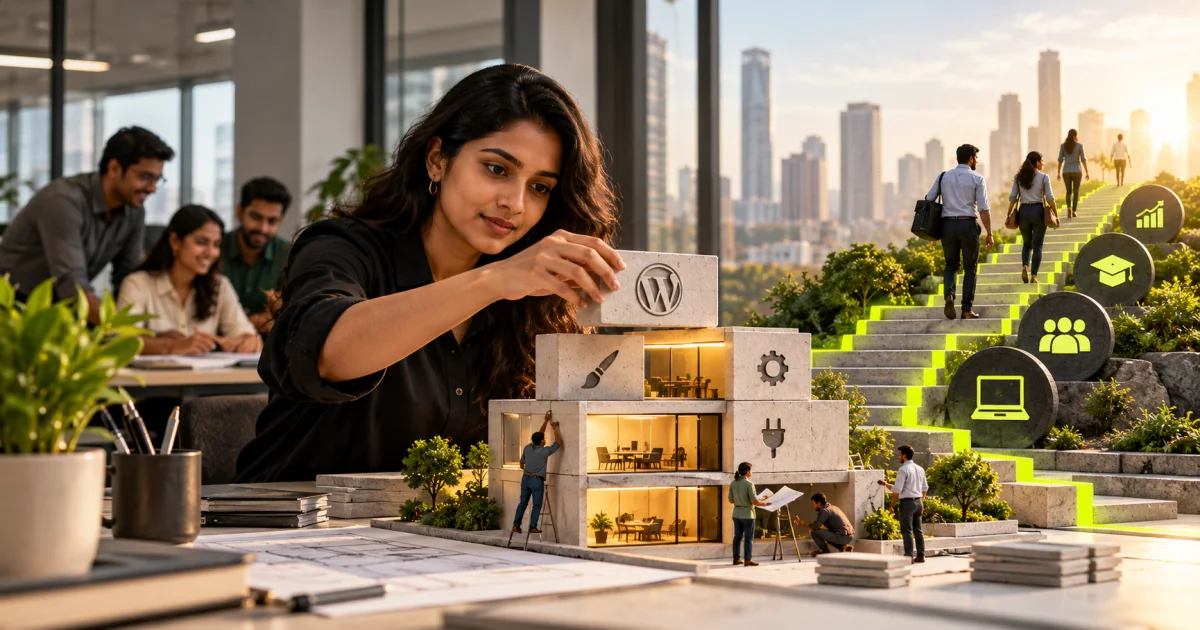
A WordPress developer career in India can include theme work, plugins, integrations, maintenance and performance or security improvements. Learn the platform alongside HTML, CSS, JavaScript, PHP and deployment fundamentals. Build projects that show maintainable code and problem-solving, and compare current job requirements before choosing a specialisation.
Search for wordpress developer career India online and you get two contradictory answers. One camp says WordPress is finished and that you should learn React instead. The other sells a course promising quick money from theme installs. Both are wrong, and the useful answer sits in the gap between them.
This is the version we give students who ask us in person. It covers where WordPress work genuinely exists in India, what separates a low paid theme installer from a developer clients pay properly, and how the freelance and agency routes differ. If you want a structured route through that stack, our 60 day web development internship covers WordPress with ACF alongside SEO and server management. Read this first, then decide.
Is WordPress Development a Good Career in India in 2026?
Yes, especially for developers interested in client websites, ecommerce and maintenance, but the entry-level, page-builder-only version is highly competitive. Installing a theme and filling in a page builder is worth very little, because anyone can learn it in a weekend. WordPress work that pays properly involves custom themes, data modelling, performance and security. That skill gap is the entire story of this career path.
The tools around WordPress have changed a lot. Block themes, full site editing and headless setups have all arrived, and plugins now do things developers once billed for. What has not changed is the underlying demand: business owners want a site their own staff can edit without raising a ticket with anyone.
Demand differs by city and industry, so avoid assuming that every region or experience level has the same job opportunities. Projects exist beyond the major technology hubs. Those buyers do not want a custom framework they cannot maintain. They want something a local team can update, and usually that means WordPress.
Is WordPress Still Relevant in 2026?
Yes. W3Techs' WordPress usage report puts WordPress on roughly two in five surveyed websites globally in October 2026. This is evidence of a substantial installed base, not proof that WordPress jobs in India are growing. Modern work includes block themes, custom blocks, PHP-based themes, APIs and WooCommerce, alongside performance and security.
Where WordPress work actually exists in India
The Indian market for WordPress is not glamorous, and that is exactly why it is steady. Clinics, manufacturers, coaching centres, real estate firms, distributors and local service businesses all need sites that non-technical staff can update themselves. WordPress still answers that requirement at a price most of them accept. The demand is spread across every city, not concentrated in three tech hubs.
Client budgets vary widely by project scope, region, maintenance needs and agency expertise. Instead of treating a single quote as a universal rate, compare specifications, deliverables and ongoing support. Development can also work closely with an SEO team to make a site crawlable and usable.
Now notice where a WordPress developer can sit inside those numbers. If you only install themes, you compete at the bottom of the first band against everyone else who can install themes. If you can build custom, make it fast and keep it secure, you get pulled into the kind of website development work that carries a real budget and a longer relationship.
| Type of work | Who buys it | What they expect from you | Where it leads |
|---|---|---|---|
| Brochure and service sites | Local SMBs, clinics, manufacturers | Fast build, clean structure, working forms, WhatsApp handoff | Volume and confidence, weak rates on their own |
| Agency production work | Digital agencies across Indian cities | Custom themes, ACF fields, deadlines, clean handover | Mentorship, code review, senior roles |
| Care and maintenance retainers | Owners of existing sites | Updates, backups, uptime, security, speed fixes | Predictable monthly income and trust |
| WooCommerce and integrations | D2C brands, distributors, retailers | Payments, shipping, tax, CRM and messaging integrations | Higher value projects and repeat work |
| Rescue and rebuild jobs | Businesses with a broken or slow site | Debugging, migration, performance, malware cleanup | Strong rates, because the client needs it fixed now |
WordPress Developer Salary in India (2026)
Salary aggregator figures provide a useful starting point, but they are not promises. Indeed's WordPress developer salary page for India reports salary estimates from submitted pay data. The snapshot researched for this update indicated an average base salary of approximately ₹22,476 per month, from 111 reported salaries, with data dated 18 February 2026. Check the linked live page for changes and compare actual advertised jobs in your city.
WordPress developer fresher salaries can differ substantially from experienced developer earnings. A template editor, a PHP/plugin developer and a WooCommerce integration specialist do different jobs. Compare in-hand pay with annual CTC, and do not confuse freelance project billing with monthly take-home income.
What determines a WordPress developer's salary?
- Hands-on experience debugging live websites and delivering complete projects
- PHP, JavaScript, custom theme and plugin development skills
- WooCommerce, integrations, Core Web Vitals and security knowledge
- City, employer, role scope and communication skills
What separates a theme installer from a WordPress developer people pay?
Ownership of the output. A theme installer arranges what somebody else's plugin already built. A developer decides the content model, writes the template, controls the queries, keeps the site fast and secure, and can fix it when it breaks at 11 pm on a Friday. Clients pay properly for the second person.
The difference shows the moment something goes wrong. A plugin update breaks the layout, the site slows to eight seconds on mobile, or a spam script starts injecting links into the footer. The installer raises a support ticket and waits. The developer opens the code and finds it.
- Custom theme development from a design file, not a purchased template with the colours changed
- Custom post types and taxonomies, so content has real structure instead of pasted HTML
- ACF and repeatable field groups the client can edit without breaking the layout
- WP_Query, hooks and filters, so behaviour is yours rather than whatever a plugin decided
- Performance work: caching, image handling, database cleanup, Core Web Vitals
- Security hygiene: updates, user roles, hardening, backups, malware cleanup
- Integrations: payment gateways, WhatsApp handoff, CRM pushes, lead pipelines
You do not need all seven on day one. Get the first three solid enough to build a real site, then add the rest one project at a time.
The stack that multiplies a WordPress profile
WordPress on its own is a commodity skill. WordPress plus search and server knowledge is not. A developer who can build a custom theme, keep Core Web Vitals in the green, set up clean URLs and structured data, and then deploy the whole thing on a VPS is solving three problems for one fee. That person is much harder to replace.
Search knowledge matters because most SMB sites exist to be found. You do not need to run campaigns, but you should understand crawlability, redirects, structured data and page speed, and how those connect to what an SEO team does after launch. Developers who ignore this ship sites that quietly fail their owners.
Server knowledge matters because cheap shared hosting is where good sites go to slow down. Learn Linux basics, Nginx or Apache, PHP-FPM, SSL, cron jobs, staging and backups. Then learn when WordPress is the wrong answer entirely, which is the judgement we walk through in our comparison of WordPress and custom builds.
Will AI Replace WordPress Developers?
AI tools and page builders can speed up design drafts, content editing and routine code generation. This puts pressure on basic theme installation work, but generated code still needs testing, security checks, accessibility reviews and debugging. A developer who understands WordPress internals, PHP, JavaScript, customer requirements and production maintenance can use AI productively rather than relying on it blindly.
WordPress vs React vs Full-Stack Development
WordPress is a CMS, while React is a JavaScript library, so the comparison is really about career goals. WordPress fits agency websites, content management, WooCommerce and client projects. React and full-stack skills fit custom applications, interactive software products and broader engineering roles. A hybrid path is possible: learn PHP, WordPress blocks, REST APIs and JavaScript, then extend into React or backend systems. Explore our WordPress vs custom website comparison for project-level trade-offs.
Freelance or agency: which route is better for a fresher?
Agency first, in most cases. An agency gives you code review, deadlines, real client feedback and exposure to problems you would never meet alone. Freelancing rewards the same skills, but it also demands sales, scoping and payment collection from day one. Learn the craft on somebody else's clients first, then decide which you prefer.
Agency work gives you structure and volume. You see how a project moves from requirement to launch, you get corrected by someone senior, and you handle briefs you would never have chosen. Ten real sites in a year teaches you more than one hobby project polished for a year.
Freelance suits people who enjoy owning the client relationship. The skill is not only code; it is scoping, writing a clear proposal, saying no to bad fits, and following up on payments without flinching. It helps to understand how businesses judge that choice, which we cover in our piece on hiring a freelancer versus an agency.
A common Indian pattern works well. Agency by day for two or three years, small freelance projects on weekends, then choose with real evidence instead of guesswork. You keep an income while you build both the skill and the client list.
How to Become a WordPress Developer in India: 7-Step Roadmap
Follow the order below. Freshers often stall because they start at WordPress and never learn the fundamentals underneath it, so the first unexpected template behaviour stops them completely.
- Learn HTML, CSS and JavaScript until you can build a responsive page from a design without a framework.
- Learn enough PHP to read a template, write a loop, and work with functions and arrays.
- Build a custom theme from a Figma file and explore block themes, Gutenberg and theme.json alongside classic PHP templates.
- Rebuild the content as custom post types and ACF fields a non-technical client can edit safely.
- Add one real integration: a payment gateway, a WhatsApp handoff, a CRM push or a WooCommerce checkout.
- Deploy it yourself on a VPS with SSL, caching, backups and a working staging site.
- Measure it, then fix what you find: Core Web Vitals, page weight, crawl errors, broken redirects.
Then publish the work properly. Three documented projects with a short note on the problem, your decisions and the result beat twenty tutorial clones, which is the case we make in our guide to portfolio projects that get freshers hired. If you are still choosing a direction, our wider guide to becoming a web developer in India maps the other routes honestly.
The honest limits of this path
The bottom of the market is being squeezed. AI tools and page builders now let almost anyone assemble a passable five page site, so basic installs will keep getting cheaper. That pressure only reaches you if basic installs are all you can do.
WordPress alone will also cap you at some point. Product companies and funded startups hire for JavaScript frameworks, backend services and cloud work, and WordPress is rarely part of that stack. Treat it as a strong first paid skill and a reliable income base, not as the last thing you ever learn.
Be careful with promises too. No program can guarantee a job, a placement or a salary, and anyone who says otherwise is selling something. We do not make that promise either; what we do is teach the stack and review your work honestly. If you want to check whether this route fits your background before you commit, reach us through our contact page and we reply within one business day.
Frequently asked questions
Do I need to learn PHP to become a WordPress developer?
Yes, enough of it. You do not need to be a full PHP application developer, but you should be able to read a template file, write a loop, use hooks and filters, and debug a fatal error without panic. That is the line between editing a site and building one.
Is WordPress still worth learning if I want a JavaScript job later?
It is a reasonable start. WordPress teaches you shipping, hosting, clients and deadlines faster than most tutorials, and it can pay while you learn. Keep JavaScript moving in parallel, and use block development or headless setups to bridge the two. That transition is common, so do not stall for years before making it.
How long before I can take paid WordPress work?
With consistent daily practice, most people need several months to reach a build they can charge for, and longer to be dependable under pressure. The variable is rarely talent. It is how many complete projects you finish end to end, including deployment, bug fixes and client handover.
Does a completion certificate help if I have no experience?
It helps a little, mainly as evidence that you finished structured work on a schedule. Interviewers care far more about what you built, how you explain your decisions, and whether the site actually runs. Treat a certificate as supporting proof and let the projects do the arguing for you.
Is WordPress development a good career for freshers in India?
It can be, particularly for freshers interested in agency or client websites who build a portfolio and learn HTML, CSS, JavaScript and PHP. Compare local jobs and avoid assuming a guaranteed salary.
What is the average WordPress developer salary in India in 2026?
A researched Indeed snapshot showed approximately ₹22,476 in average monthly base pay, using 111 salary reports as of February 2026. Individual offers vary, and a salary average is not a guaranteed starting rate.
Will AI replace WordPress developers?
AI automates some routine tasks, but complex integrations, production debugging, security, performance and site maintenance still require accountable technical work.
Should I learn WordPress or full-stack development?
Choose WordPress for CMS websites, agency production and WooCommerce. Choose broader full-stack skills if you want to build custom applications and SaaS; programming fundamentals and JavaScript are useful in either path.
Your next 60 days
If you want the structured version of everything above, that is what our program was built for. It runs 60 days: 45 days of guided training followed by 15 days of project work, and it is open to students, freshers and working professionals. The curriculum covers UI/UX design, HTML and CSS, frontend, backend development, SQL, MongoDB, WordPress with ACF, SEO, and server management and deployment.
The fee is a one time Rs 899, paid through Razorpay by UPI, card or netbanking, and card and UPI details are not stored. Learners who complete the training and the project requirements receive a completion certificate. Refund and cancellation terms are published on our policy page and depend on onboarding status and timing. Support runs Monday to Saturday, 10:00 AM to 7:00 PM.
WordPress is not a dead end, and it is not a shortcut either. It is a market where the skilled half is paid well and the unskilled half is paid badly, and what you can build decides which half you land in. Start with the fundamentals, ship real projects, document them, and if you want a guided route through the stack, see what the 60 day internship covers.