B2B lead generation for manufacturers works best when buyers can check your capabilities, request a quotation and receive reliable follow-up. Indian manufacturers can combine marketplace listings with a website, relevant search pages and a simple enquiry workflow, then measure qualified requests and orders by channel.
If most of your enquiries come from IndiaMART or TradeIndia, you already know the pattern. The phone rings, a buyer asks for a rate on a drawing, and three competitors are quoting the same part the same afternoon. That is not a sales problem. It is a channel problem, and it is why b2b lead generation for manufacturers India so often stalls at the quotation stage.
The fix is not to leave the marketplaces. It is to build a second channel you own, so that some buyers reach you before they open a comparison sheet. We build that channel for plants across Akurdi, Chinchwad, Chakan and Makarpura GIDC, and it rests on ordinary marketing fundamentals rather than anything exotic. Below is what to build, in what order, and what it realistically costs.
Why marketplace enquiries arrive already comparing price
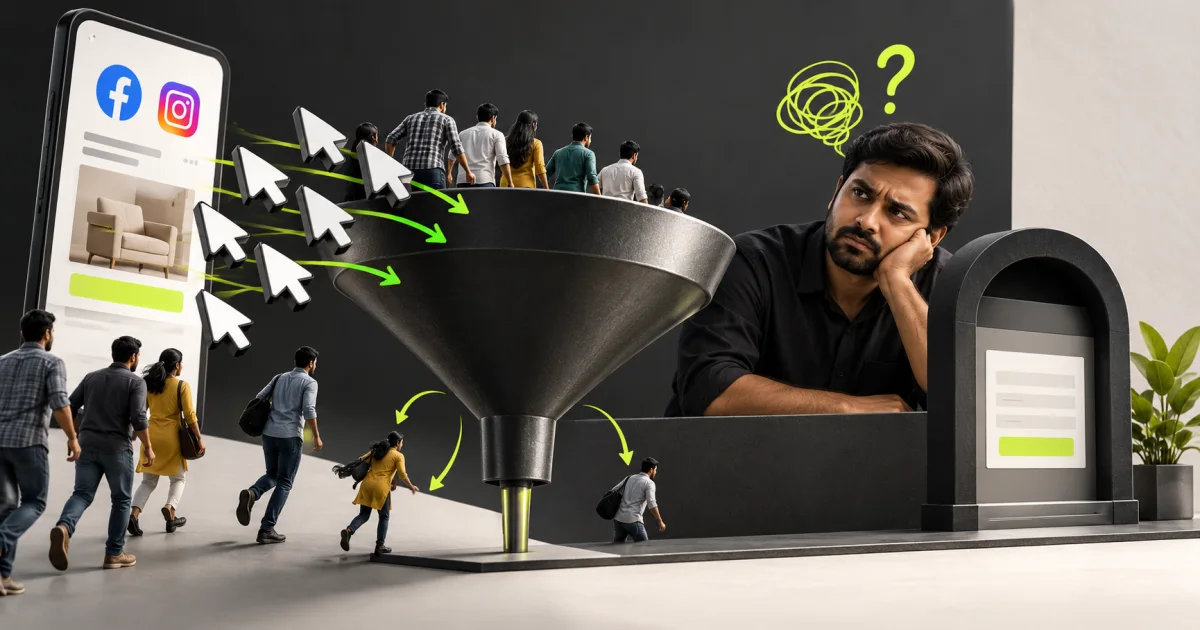
Marketplaces are built for price discovery. That is their job and they do it well. A buyer posts a requirement, the platform pushes it to several suppliers at once, and the buyer's first screen is a list of names sitting next to each other. By the time you speak, the frame is already set: who is cheapest for this part.
Marketplaces can help buyers discover suppliers, but they also place competing businesses side by side. Keep useful listings while building your own capability pages and enquiry process, so you can compare qualified requests from each channel rather than relying on marketplace reach alone.
An owned channel behaves differently. A buyer searching a process, a material grade or a part family lands on your page, reads your tolerances and your machine list, and writes to you with a question instead of a blast RFQ. Same buyer, different frame, different margin.
What are IndiaMART and TradeIndia actually good at?
They are good at volume, reach and discovery. A listing puts you in front of buyers in cities where you have no sales presence, and it usually costs less per enquiry than the channels you are still building. For a new plant or a new capability that is genuinely useful, and enquiries arrive in weeks, not months.
A manufacturer does not need a market-size forecast to test digital demand. Publish clear capabilities, target buyer questions and record how qualified enquiries arrive. Use your own conversion and order data to decide whether a channel deserves more investment.
So treat them as what they are. They do a few jobs better than anything else you can buy:
- Reach into buying cities where you have no sales presence
- Enquiries from week one, with no waiting for a site to gain traction
- Discovery for a new capability or a new part family
- A rough read on what kind of enquiry your category attracts
- Cover while the slower channels are still being built
Where marketplace dependence caps you
The cap shows up in four places. Margin comes first, because a channel designed for comparison rewards the lowest quote and trains buyers to expect one. Second, you do not own the relationship; the buyer belongs to the platform, and your visibility depends on the tier you pay for this year.
Third, there is no audience to return to. You cannot message last year's enquirers about a new machine or a new process, because that list was never really yours. Fourth, nothing compounds. Stop paying and the enquiries stop the same month, whereas a page that ranks keeps working long after the invoice is settled.
None of that makes marketplaces a mistake. It makes them a floor, not a ceiling. The plants that grow margin keep the listings running and add a channel that carries what a marketplace cannot: repeat buyers, larger contracts, and procurement teams who vet you before they shortlist you. If you are weighing channels more broadly, our overview of how Indian businesses build enquiry flow covers options outside manufacturing too.
| Channel | What it does well | Where it caps you | Sensible role |
|---|---|---|---|
| IndiaMART and TradeIndia | Volume and reach, quickly | Price-first framing, rented audience | Top of funnel, keep running |
| Capability website and search | Buyers who arrive with a question, not an RFQ blast | Slow to build, and no position is guaranteed | The asset you own |
| Google Business Profile | Trust checks, map visibility, directions to the unit | Limited pull from buyers far outside your region | Verification layer |
| Google Ads | Visibility on specific intent within weeks | Stops working the day you pause spend | Testing and filling gaps |
| Existing buyers and referrals | Best margin, shortest cycle | Usually unmanaged and easy to neglect | Systematic follow-up |
B2B lead generation for manufacturers India: the five owned assets
An owned system has five parts. Build them in this order, because each one makes the next cheaper to run.
- A capability website a procurement engineer can evaluate without calling you.
- Process, material and part pages written in the words buyers actually search.
- A Google Business Profile that survives a trust check.
- A quotation follow-up workflow that no enquiry falls out of.
- Proof, in the form of application stories: the constraint, the fix, the result.
Two of these get skipped most often. A Google Business Profile feels irrelevant for a unit that never sees a walk-in, but buyers use it as a trust check: photos, address, hours, reviews, the sense that a real plant stands at that address. If you run ads alongside, note that industry reporting in 2026 describes Performance Max as the dominant Google Ads campaign type for Indian advertisers, which makes clean conversion tracking a prerequisite rather than a refinement.
Budget from the actual scope rather than a generic price band. RKWS landing-page builds start at ₹2,000 one-time; multi-page websites, custom portals and integrations need a separate quote. Confirm content, testing, ownership, maintenance and third-party subscriptions before comparing proposals.
What should a capability website show a procurement team?
Show what a buyer needs to shortlist you: machines with make and capacity, tolerance ranges, materials handled, certifications, inspection equipment, batch sizes you accept and turnaround. Add plant and QC detail, GST and registration particulars, and a drawing upload form. A procurement engineer should be able to say yes or no without a call, and an overseas buyer evaluating a supplier entirely online needs the same page to carry certification scope, capacity and trade terms.
Manufacturing sites tend to fail this test in the same way. They open with a founder's message and a photograph of a handshake, then bury the machine list inside a PDF nobody has updated in years. Procurement teams are not reading your vision. They are checking whether you can hold the tolerance and deliver the quantity on the date.
Two details punch above their weight. First, a capability deck a buyer can download without surrendering an email address, because forcing the form loses the buyers who were only building a shortlist. Second, a published commitment on response time, since slow replies waste enquiries you have already paid for. We reply within one business day and say so in writing; set your own standard and put it on the page.
How do you rank for technical part and capability terms?
One page per process, material and part family, written with the words buyers type: job work, machining, fabrication, grade names, drawing terms. Give each page a specification table, tolerances, capacity and real photographs. Then earn links and citations from suppliers, associations and directories. Rankings take months, and nobody can promise them.
The search volumes here are small, and that is the point. A query for a specific grade or process plus a city may run a handful of times a month, but the person typing it is a buyer with a live requirement, not a student. Ten narrow pages beat one page trying to cover the whole plant.
The results page has also changed shape. Industry reporting in 2026 suggests Google AI Overviews appear in roughly 20 percent of searches, and that about 60 to 63 percent of Google searches end without a click. Pages that answer the specification question directly, in text a machine can parse, still get quoted and still earn the click that matters. Our search work for industrial clients is built around that rather than around broad head terms.
The quotation follow-up workflow most plants are missing
Ask a plant how many quotations went out last quarter and you get a number within a minute. Ask how many were followed up twice and the room goes quiet. This gap costs very little to close, because these buyers already raised their hand.
- Capture every enquiry in one place, whatever the source: marketplace, phone, WhatsApp, email or website form.
- Acknowledge within one business day, from a named person, with a realistic date for the quotation.
- Send the quotation with a short scope note, not only a rate.
- Follow up twice on WhatsApp Business, spaced a few days apart, with one useful question each time.
- Mark every enquiry won or lost, with the reason in plain words.
- Review the lost reasons once a month and fix the pattern, not the individual deal.
Automate the boring half. Enquiries route into one sheet or CRM, acknowledgements fire on their own, and reminders sit in front of the person who owes the quotation. We have written up the mechanics of chasing enquiries without chasing people and of automation inside manufacturing SMEs. Start with capture and acknowledgement; the rest can wait a quarter.
Proof is the last asset, and the most neglected. Write up three jobs you are proud of: the requirement, the constraint, what you changed, what the buyer got. Keep them anonymous where an NDA applies. Buyers cannot verify a claim about quality, but they will recognise a problem that resembles their own.
If you want a second opinion on which capabilities deserve their own page, send us your machine list and we will tell you where the searchable demand sits.
Frequently asked questions
Should we cancel our IndiaMART subscription once the website starts working?
Usually no. The two channels reach different buyers at different moments, and cutting the listing removes volume before the replacement is carrying its share. Run both for two or three quarters, record where each closed order came from, then decide with numbers rather than frustration.
How long before an owned channel produces enquiries?
Plan in months, not weeks. Campaigns can be live in two to four weeks and a Google Business Profile can start showing sooner, but capability pages usually need several months to gain traction, and no agency can guarantee a position. Follow-up is the exception; it starts working as soon as you put it in place, because those buyers have already enquired.
Do buyers in our category really search on Google?
Yes, and more than they will admit. Procurement teams search to build a shortlist, to check a supplier a colleague named, and to find a capability their usual vendor cannot deliver. They may still route the final order through a marketplace, which is one more reason to keep both channels open.
What does this cost to start?
At RKWS, SEO starts at ₹3,500 per month, digital marketing starts at ₹3,000 per month and Google Business Profile management starts at ₹2,000 per month. Each is a separate scope. Larger catalogues, additional locations and technical repairs require assessment, while paid media spend is separate from management fees.
Where to start this quarter
Pick the order by what is leaking. If enquiries arrive and then die, fix follow-up first; it costs least and pays back fastest. If enquiries arrive but always on price, build the capability pages. If enquiries are simply too few, keep the listings running and add search alongside.
A realistic first quarter looks like this. Weeks one to four: scope the capability site, collect the content, put the quotation workflow live and complete the Google Business Profile. Weeks five to twelve: build and launch the site, publish the first process pages, and get campaigns live within two to four weeks of sign-off. We work in Connect, Build, Launch, Optimise, with a checkpoint every week.
RadhaKrishna Web Solutions supports businesses in Pune, Maharashtra, and Vadodara, Gujarat, through remote project delivery. We do not currently operate a customer-facing office. Contact the RKWS team to discuss your requirements and agree the next steps.