Restaurant digital marketing in India works best when people can find accurate menus, opening hours, location details and a reliable way to book or order. Coordinate your website, eligible local listings and customer communications. Measure reservations, orders and repeat visits rather than relying only on social-media engagement.
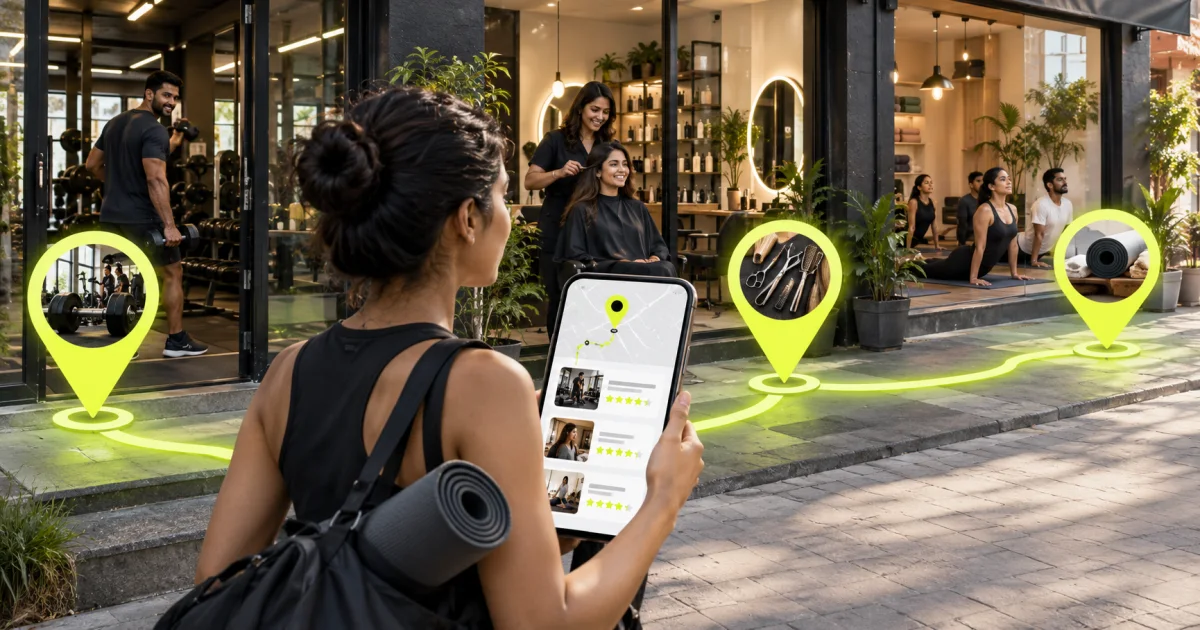
A restaurant in Baner or Alkapuri loses more covers to a stale Google listing than to a slow kitchen. Someone two streets away opens Maps, types "cafe near me", and picks from three results with photos, timings and a recent review. If your hours are wrong on a holiday, you were never in that shortlist. This guide to restaurant digital marketing India starts with the map, not the website.
For a restaurant the online storefront is the Google listing, which is why we treat profile management as the main channel and not an afterthought. Your website still matters, mostly as the place that takes a direct order or a table booking without paying a middleman. Instagram matters too, but as craving and discovery rather than as a booking system. Everything else follows from those three.
Restaurant digital marketing India: where the orders actually come from
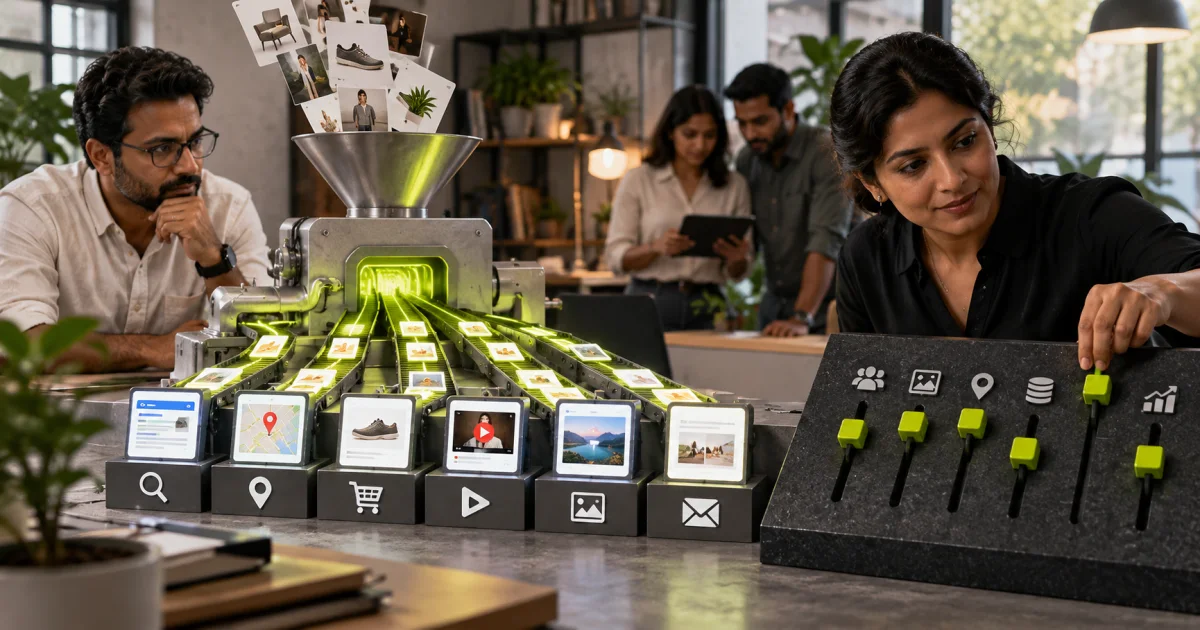
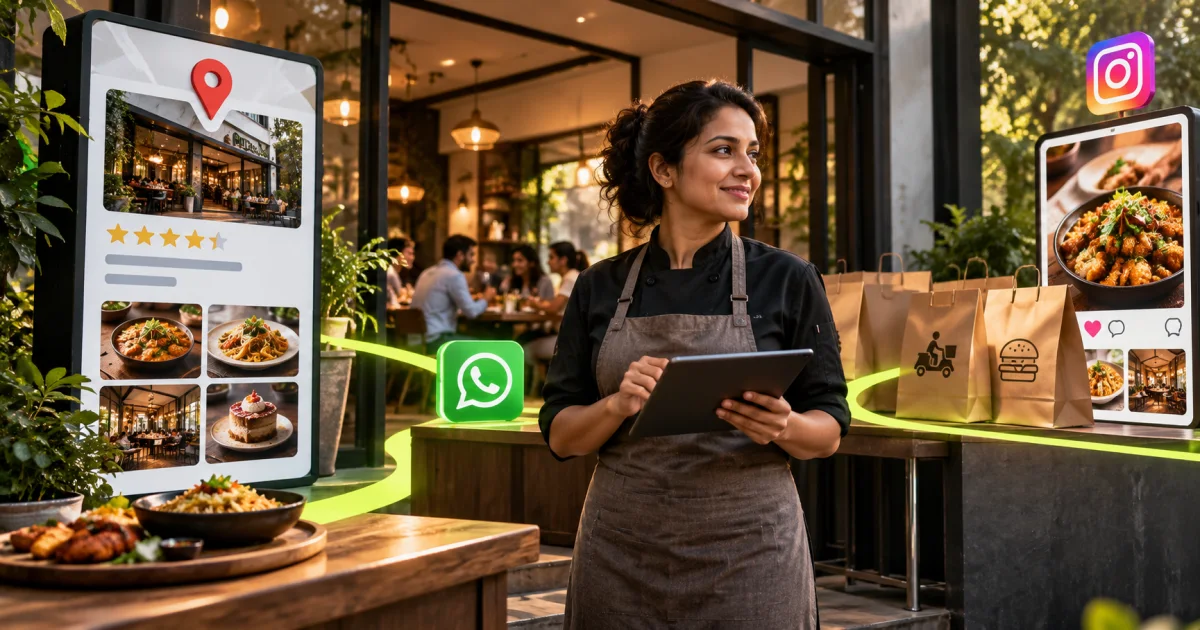
Demand reaches a restaurant through a few doors, and each behaves differently. Map and local search catch people who are already nearby and already hungry. Aggregator apps catch people who have decided to order in and are choosing between kitchens. Social catches people who were not thinking about food until they saw yours.
Rank those doors by margin, not by volume. A direct order at full price is worth more than a discounted app order, even when the app sends more. The aim is not to abandon aggregators but to build a direct channel strong enough that you stop depending on one.
- Google Maps and local search: highest intent, closest to your door, cheapest to win.
- Aggregator apps: real volume, thinner margin on every order.
- Instagram and Reels: craving, discovery, and the reason a first-timer notices you.
- WhatsApp: reservations, large tables and repeat orders from people who already like you.
- Your own website: direct ordering, catering enquiries and the menu people check first.
Why is your Google Business Profile the real storefront?
Because the decision often happens before anyone reaches your website. They see your photos, your rating, your timings and your distance inside Maps, and they choose from that panel. A complete profile with fresh photos and correct hours wins the tap. A thin one loses that tap silently, and you never see it.
Three fields do most of the work: primary category, hours and photos. Pick the category that matches how people describe you, not how you describe yourself. A place selling filter coffee and dosa gets found as a South Indian restaurant, not as a multi-cuisine family dining destination.
Holiday hours are the setting that quietly costs money. Diwali, Ganpati days, 31 December, local bandhs and your own weekly off all need to be entered in advance as special hours. When Maps says open and your shutter is down, you earn a one-star review for something the kitchen did not do. Set them a month ahead, not on the morning itself.
The rest of the profile is housekeeping that compounds. Add the menu link, service options such as dine-in, takeaway and delivery, and attributes such as outdoor seating, parking or pure veg. Our walkthrough of how a local profile should be built out properly applies almost line for line to a restaurant.
Google Business Profile checklist for restaurants
- Primary category: the most specific cuisine or format that fits, such as South Indian restaurant, cafe or bakery, with a few accurate secondary categories.
- Hours: regular hours plus special hours entered in advance for festivals, holidays and your weekly off.
- Menu: a link to an up-to-date menu on your own website, plus clear photos of the current menu card.
- Service options and attributes: dine-in, takeaway, delivery, pure veg, outdoor seating, parking, family-friendly, whichever genuinely apply.
- Ordering and booking links: your own website or WhatsApp booking link where the profile allows it, so direct orders are one tap away.
- Photos: the entrance as people see it from the street, the seating area, your best-selling dishes and the menu, refreshed every month.
- Posts: weekly specials, festival menus and events, so the profile looks active.
- Reviews: a reply to every review within a couple of days, especially the critical ones.
- Phone and website: a number that is answered during service hours, and a website showing the same name, address and hours.
Photos, menu accuracy and what people check before walking in
Photos are not decoration. They are the shortlist. A dark, flash-lit plate loses to a clear daylight shot every time, and the person who scrolled past never tells you why.
Shoot in daylight, near a window, with the plating you actually serve at 8 pm on a Saturday. Replace the cover photo whenever the space changes. Add a few new images every month so the profile does not look abandoned.
- The exterior from the road, so people recognise the entrance from a moving vehicle.
- Six to ten bestsellers, one dish per frame, no clutter around the plate.
- The menu as readable images and as a link, so nobody has to pinch and zoom a PDF.
- Whatever people ask about before coming: parking, high chairs, the terrace.
Menu accuracy matters more than menu design. Prices that are three revisions old create arguments at the counter and reviews you cannot delete. Fix the menu everywhere it appears: profile, website, aggregator listings and the printed card.
How do you build review velocity and handle a bad one?
Ask every satisfied table, every day, in a way that takes one tap. Steady flow beats a burst: reviews that keep arriving week after week read as a living restaurant, while a cluster that lands in a few days reads as a campaign. Reply to all of them. Reply to the bad ones fastest.
The mechanics are simple, and they are still the part kitchens skip. Put a QR to your review link on the bill folder and near the exit, not on every table where it gets ignored. Train the person handing over the bill to ask once, warmly, without a script. There is more detail in our piece on building a steady flow of Google reviews, including wording and placement.
Now the bad review. Reply within a day, in public, in plain language. Own the specific thing, say what has changed, and offer to continue on a call or on WhatsApp. Do not argue, do not comment on the customer's behaviour, and never offer a discount in public.
A four-part reply works: acknowledge, be specific, state the fix, invite them back. "Thanks for telling us, the paneer going out cold on Sunday is on us." Future readers are the real audience here, not the reviewer.
Aggregators or direct orders: which one protects your margin?
Aggregators buy you reach and cost you margin on every order, and the exact rate changes by city, contract and promotion, so check your own statement rather than any published number. Direct orders keep the full ticket and the customer's phone number. The sensible position is both, with a deliberate push toward direct.
Treat the app as paid acquisition, not as your business. You own the second order only if you captured a way to reach that person yourself.
| Channel | Best at | What it really costs | What you own afterwards |
|---|---|---|---|
| Aggregator apps | Volume from people ready to order in | A cut of every order plus discount funding, at rates set by your contract | Very little; the customer belongs to the app |
| Google Business Profile | Nearby, high-intent discovery and calls | Time spent on photos, hours and replies | The call, the walk-in and the review |
| Reservations, large tables, repeat orders | A number, a catalogue and someone who answers fast | The conversation and the opt-in | |
| Your ordering page | Full-price direct orders and catering enquiries | Build cost plus UPI or a gateway such as Razorpay | Order history, phone numbers, margin |
| Craving, discovery, first visits | Consistent content effort every week | Saves and follows, rarely a booking |
Direct ordering does not need a large build. A clean menu page, a UPI or Razorpay checkout and a WhatsApp fallback covers most independent kitchens, and we usually ship that as a small ordering site rather than a full rebuild. Work like that sits at the shorter end of our usual six to twelve week website timeline.
WhatsApp is your booking desk, Instagram is your craving channel
WhatsApp is where Indian restaurant bookings actually happen. People will not fill a form to reserve a table for six on Saturday, but they will send a message. Use WhatsApp Business, load a catalogue, set an away message with your real hours, and answer within minutes during service.
Automate the boring half. A greeting that states timings and the reservation link, a quick reply for the parking question, and a nudge to regulars before a festival weekend all run without a person. We cover the setup and its limits in our guide to automating customer conversations on WhatsApp.
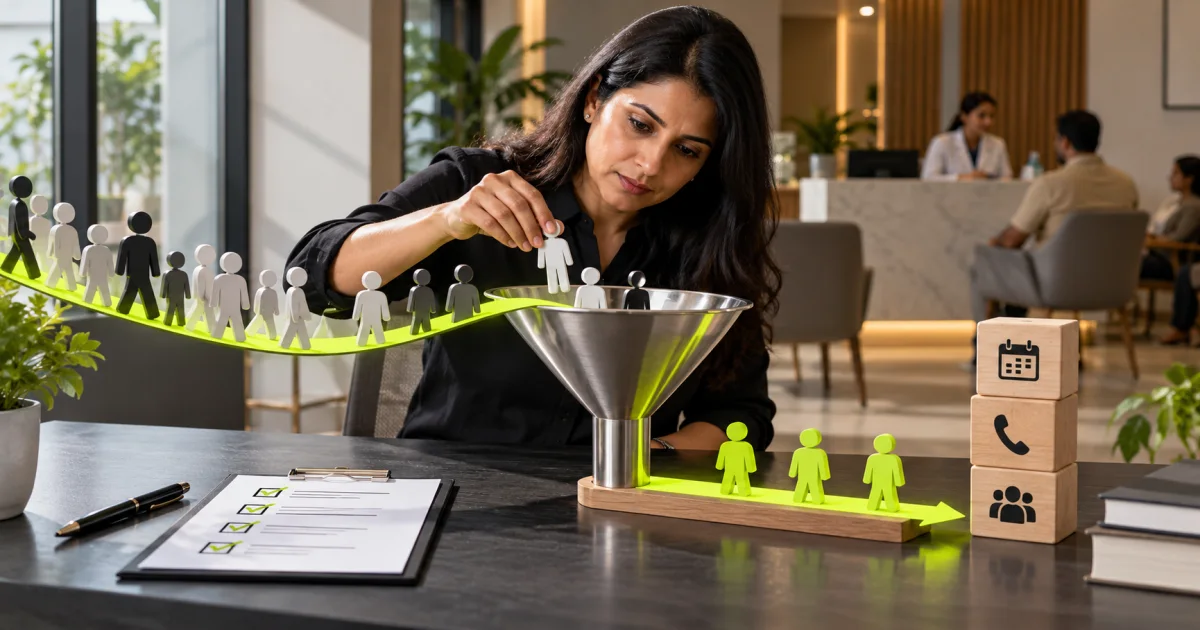
Instagram deserves an honest description. It builds craving, it makes a new place look alive, and it earns saves and shares. It rarely closes a booking on its own. Treat it as the top of the funnel and put the booking action in the bio, in the story sticker and in every reply.
Post what makes people hungry, not what makes you proud. The dish being plated, the tandoor, the first pour of a cutting chai, the Sunday queue outside. Tag the location every single time, because location tags are how people nearby stumble onto a new place. If you want this run properly alongside your profile and your ads, tell us what a normal week looks like and we will say what we would fix first.
How does local discovery work for someone two streets away?
Proximity, prominence and relevance decide it. Google reads where the searcher is standing, how complete and active your profile is, and whether your categories, menu words and reviews match what was typed. You cannot move your building, so you compete on the other two. That is the whole game in local.
Nobody can promise you the top of the map pack, and we do not. What we can do is remove the reasons Google has to leave you out: wrong categories, missing hours, stale photos, thin reviews and inconsistent details across directories. Our breakdown of what actually influences map pack placement runs through the checks in order.
Search results themselves are shifting, and that changes how many people reach a website at all. Industry reporting in 2026 puts AI Overviews in roughly 20 percent of searches, with about 60 to 63 percent of Google searches ending without a click. For a restaurant that is survivable: your hours, rating and number already sit in the result. It does mean the profile has to carry information that used to live on a page.
Consistency across listings still matters. Your name, address and phone number should read identically on Google, JustDial, aggregator apps, your website footer and your Instagram bio. Mismatched entries split the signal and send customers to an old number. Restaurants in Baner, Wakad, Kothrud and Aundh compete street by street, which is the work we do for local businesses across the city, and for Vadodara clients from the same Pune team.
Frequently asked questions
How much should a restaurant spend on digital marketing in India?
At RKWS, SEO starts at ₹3,500 per month, digital marketing starts at ₹3,000 per month and Google Business Profile management starts at ₹2,000 per month. Each is a separate scope. Larger catalogues, additional locations and technical repairs require assessment, while paid media spend is separate from management fees.
Do I need a website if I am already listed on aggregator apps?
Budget from the actual scope rather than a generic price band. RKWS landing-page builds start at ₹2,000 one-time; multi-page websites, custom portals and integrations need a separate quote. Confirm content, testing, ownership, maintenance and third-party subscriptions before comparing proposals.
How long does local SEO take to show results for a restaurant?
Profile fixes such as hours, categories and photos can change how you appear within days. Review velocity and ranking movement take longer and depend on how crowded your street is. We do not guarantee rankings, and you should be wary of anyone who does. Campaigns we run go live in two to four weeks, with weekly checkpoints after that.
Should a restaurant run Google Ads or Instagram ads first?
Google first, usually, because it reaches people who are already deciding where to eat. Published 2026 analyses suggest Performance Max has become the dominant Google Ads campaign type for Indian advertisers, which makes creative and feed quality matter more than long keyword lists. Instagram ads earn their place for a launch, a new menu or a festival offer.
Where to start this week
You do not need a full strategy to make progress. Fix the profile, then the photos, then the review habit, then the direct channel. That order matters, because each step makes the next one cheaper.
- Claim and verify your Google Business Profile, and set the primary category correctly.
- Enter special hours for the next three months, including festivals and your weekly off.
- Shoot fifteen daylight photos this week and upload them across the next fifteen days.
- Put a review QR on the bill folder and brief whoever hands the bill over.
- Switch to WhatsApp Business, add the catalogue and a greeting that states your timings.
- Add a direct ordering or booking path to your website with UPI or a payment gateway.
- Reply to every review from the last six months, oldest first.
Most of that is free and needs attention rather than budget. Running it consistently every week, instead of in one burst during month one, is where an agency earns its fee. Our method is plain: connect, build, launch, optimise, with a reply from us inside one business day. Send us your menu, your city and what a good Saturday looks like, and we will map out the first ninety days with you.