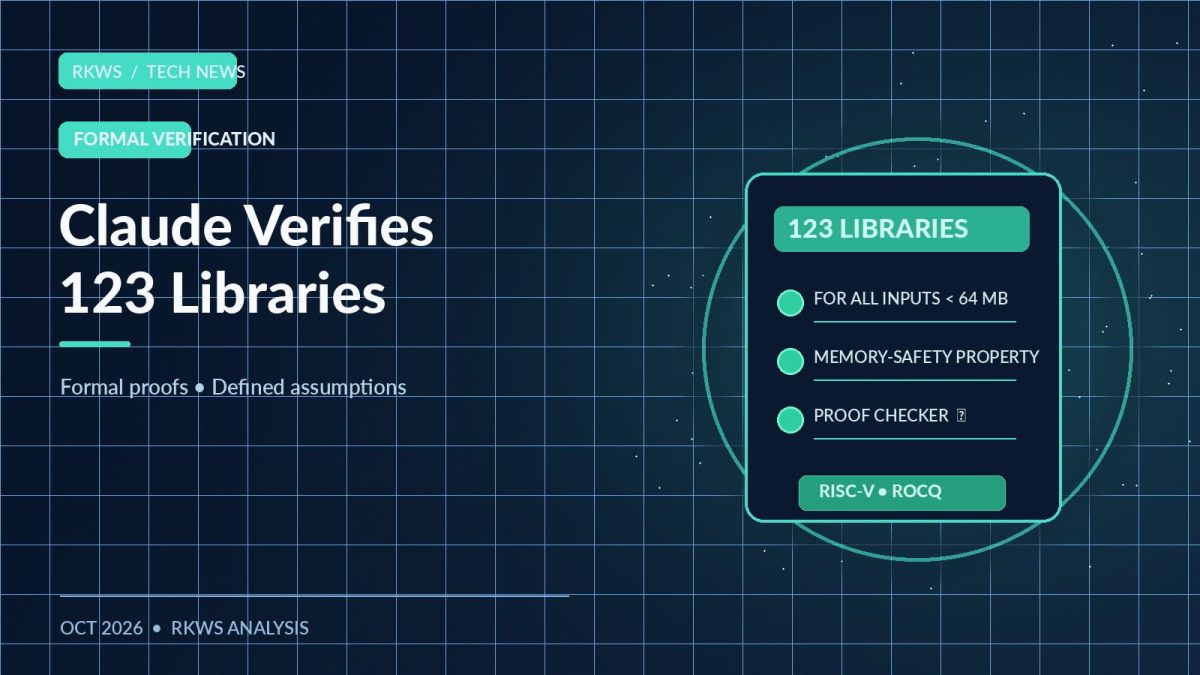
Anthropic says Claude helped formally verify selected security properties in 123 open-source libraries. In research released on 22 October 2026 with Theorem, the team proved 239 fuzz-test entry points satisfy specified no-crash conditions in a modeled RISC-V/Linux environment. This is an important advance in AI-assisted software assurance, but it does not mean every library is bug-free or safe in every production configuration.
The figures and proof limitations come from Anthropic's original formal-verification research. This RKWS explainer was checked on 25 October 2026 and does not claim independent verification of the published proof artifacts.
What is AI-assisted formal verification?
Formal verification uses mathematics and precise specifications to show that software behaves according to defined rules. Testing executes selected examples and tries to find failures; a valid formal proof shows that a stated property holds across the modeled possibilities under its assumptions.
AI-assisted verification means a language model contributes to generating proof steps or specifications. A proof checker then checks those steps. The validity of the claim still depends on the specification, the checker and the model of the real hardware or software environment—not the confidence of the language model.
What exactly did Anthropic and Theorem verify?
Anthropic reports using Claude with Theorem's tools to convert existing fuzz tests into formal specifications, then prove defined safety behavior for compiled programs. The research used RISC-V machine code and modeled Linux semantics rather than checking every possible production architecture directly.
| Research measure | Reported result | What it means |
|---|---|---|
| Open-source libraries | 123 | Distinct libraries included in the scoped proof effort |
| Fuzz-test entry points | 239 | Specific callable test surfaces covered |
| Input limit in stated proof | Inputs smaller than 64 MB | Not an unlimited-input guarantee |
| Proof artifact size | About 180 million lines of Rocq | Machine-checked proof code, not manually reviewed line by line |
| Modeled environment | Single-threaded static RISC-V/Linux | Not a direct claim about all x86, ARM or multithreaded deployments |
These details are from the 22 October 2026 research paper. Anthropic says it is releasing a subset of proofs and verification components, while retaining some material that could disclose unpatched vulnerabilities.
How did Claude turn fuzz tests into proofs?
Fuzz testing sends many unusual or randomized inputs to a program to find crashes. It is valuable but cannot exhaust all possible inputs. The researchers used existing OSS-Fuzz test entry points as starting specifications and attempted to prove those entry points never trigger the specified failure modes within a defined environment.
- Select an open-source library and a compiled fuzz-test entry point.
- Model the binary's relevant machine and operating-system behavior.
- Translate the expected no-crash behavior into a precise theorem.
- Have Claude propose and revise the proof, and in some experiments patch bugs blocking it.
- Use the Rocq proof checker to verify the formal result.
- Preserve the trusted assumptions and review any code changes independently.
For a developer, the important difference is that the proof checker accepts or rejects logical proof steps. The AI model does not become the authority deciding its own correctness.
What kinds of security issues emerged?
Anthropic reports discovering hundreds of bugs while attempting proofs, including memory-safety failures that conventional fuzzing struggled to find. Examples discussed in its report include rare decompression and image-decoding input patterns, as well as logic errors that might not cause a crash at all.
Such discoveries illustrate how attempting a proof can uncover previously neglected code paths even if a complete proof is not achieved. The research also describes cases involving file-access restrictions and a rediscovered libexpat vulnerability.
This blog deliberately avoids presenting those descriptions as newly confirmed vulnerabilities affecting every installed copy of those libraries. Developers should follow maintainer advisories and coordinated vulnerability disclosure rather than infer an exploitable server risk from a general research article.
Does formal verification mean software is completely safe?
No. A valid proof is only as broad as its specification and modeled assumptions. Anthropic explicitly cautions that its work cannot prove an entire codebase free of all bugs. The analyzed programs were modeled as single-threaded static RISC-V binaries with a fixed memory budget and specific Linux responses.
| What a scoped proof can establish | What it does not automatically establish |
|---|---|
| A stated no-crash property for modeled inputs | No errors outside the verified entry points |
| Behavior under specified machine and OS semantics | Identical behavior on all actual deployed hardware |
| Absence of certain detectable memory errors | Absence of all security vulnerabilities or logic flaws |
| Machine-checkable proof under assumptions | That the specification perfectly matches business intent |
For example, a proof of no memory-safety crash does not guarantee that a payment system applies the correct discounts, respects permissions or never leaks private information. Teams still need requirements review, security testing and business-level acceptance criteria.
What role does the Rocq proof checker play?
Rocq is a proof assistant that can validate formally constructed statements. Rather than asking reviewers to read millions of lines of generated proof, the checker validates whether the theorem follows from the encoded definitions and proof rules.
Trusted components still matter. Researchers must trust the correctness of the proof checker and formal machine and operating-system models. This concentrates assurance work onto a smaller set of components but does not remove the need to test the assumptions against real deployments.
Why is this news important for AI coding agents?
AI coding tools can write code rapidly, but generating software faster is useful only when teams can also review and validate it. Scalable formal proof generation may eventually make stronger software assurance practical for more common libraries and components, especially where crashes or memory corruption are expensive.
However, do not sell AI-generated proofs as a replacement for code review or security governance today. Our AI coding agents article covers human engineering roles, while the security checklist explains where agent access and deployment policies remain critical.
How can a development team start with formal methods?
Begin with a property small enough to state precisely. An unambiguous requirement is often harder than writing a unit test, and a weak specification may produce a technically valid proof of the wrong thing.
- Choose a high-value component, such as a parser or validation routine.
- Define a property such as no out-of-range access or correct round-trip encoding.
- Document limits, dependencies and environmental assumptions.
- Run existing unit, integration and fuzz tests to establish a baseline.
- Explore a proof tool and verify each generated proof with an independent checker.
- Review generated patches for functional regressions and unintended changes.
- Retain normal production monitoring, response procedures and update processes.
For production considerations, see our AI agent monitoring guide and website security controls for small businesses.
What are the biggest limitations of the 123-library study?
The research does not cover all architectures, all configurations or all public functions of each library. It also cannot guarantee that external callers use each verified component correctly. A specification may omit behaviors that matter in the real world, and AI-generated code patches deserve independent review.
Anthropic's work is a promising research demonstration, not a certificate that a business may discontinue penetration testing or skip software updates. Teams should treat the proof as one scoped piece of evidence in a broader assurance process.
Frequently asked questions
Did Claude prove 123 entire libraries are bug-free?
No. The research proved specified properties for 239 entry points across 123 libraries under limited modeling assumptions.
What is the difference between testing and formal verification?
Testing evaluates selected examples. Formal verification attempts to prove a defined property holds across the modeled input space.
What checker did the project use?
The researchers used Rocq to machine-check generated proofs.
Can the results be used directly for my production server?
Only after evaluating the specific component, binary, environment and assumptions. The RISC-V scoped results are not automatic guarantees for an unrelated production deployment.
Can AI replace experienced security reviewers?
No. Humans still define the requirements, review patches, validate assumptions and own release and incident decisions.
Conclusion: stronger guarantees with explicit boundaries
The meaningful result is that Claude helped build checkable security proofs at previously difficult scale. Equally important is the boundary: 123 libraries and 239 test entry points do not imply zero vulnerabilities everywhere. Development teams should experiment with formally stated properties while retaining normal review and testing. Contact RKWS for secure software engineering guidance.
Primary source: Anthropic and Theorem, LLMs are making formal software verification feasible at a much larger scale, 22 October 2026.