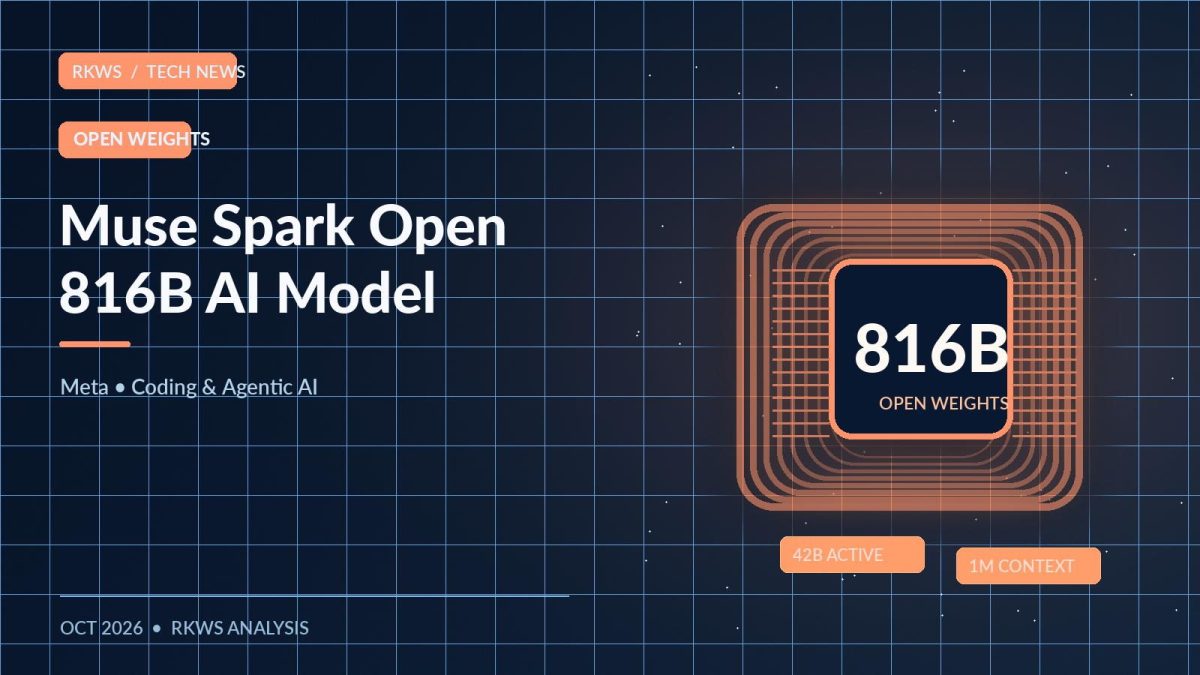
Meta released Muse Spark Open on 15 October 2026. This open-weight AI model has 816 billion total parameters, about 42 billion active parameters per token, and a one-million-token context window. It supports text, image, video and audio inputs and targets coding and multi-step AI agents. Developers can download the weights or use hosted providers, but its large hardware requirements and limited commercial license deserve careful review.
The figures and availability described here come from Meta's developer release, Meta AI Research and the official model documentation. Research checked 25 October 2026. RKWS has not run its own Muse Spark Open benchmark.
What exactly is Meta Muse Spark Open?
Muse Spark Open is the downloadable-weight version of Meta's Muse Spark family, designed for long-running agent tasks including coding, tool calls and working through large contexts. It is open weight, meaning developers can obtain model parameters and run inference on infrastructure of their choice subject to the license. That does not mean the entire training data or training pipeline has been released without restrictions.
The company describes it as a native multimodal input model: text, images, audio and video can inform its text response. Teams should not assume the model directly generates all those media types, because the official model table specifies text output.
Why does Muse Spark Open have 816B parameters but only 42B active?
The model uses a sparse mixture-of-experts (MoE) architecture. Instead of applying all 816 billion parameters to every token, routing selects a smaller set of experts for each token. Meta says the active portion is approximately 42 billion parameters.
This distinction improves the amount of computation needed for each generated token, but does not magically reduce all memory requirements to a 42B model. Serving infrastructure still needs to store or retrieve the total weights, maintain the context cache and accommodate runtime overhead.
| Technical characteristic | Meta's stated specification | Practical implication |
|---|---|---|
| Total parameters | 816B | Very large stored model |
| Parameters active per token | About 42B | Only a subset contributes to a token |
| Maximum context | 1,048,576 tokens | Long source materials are possible; test actual accuracy and costs |
| Input modalities | Text, image, audio, video | Multimodal document and agent tasks |
| Output | Text | Do not assume native image or audio generation |
| License | Muse Model License | Check commercial restrictions before deployment |
How much hardware is needed to self-host Muse Spark Open?
Hardware needs vary by checkpoint precision, context size and inference engine. Meta's documentation says the BF16 reference weights are approximately 1.65 TB and a compressed NVFP4 version is roughly 537 GB. Those figures describe weights, not complete memory budgets.
According to Meta, the full BF16 version can serve across multiple enterprise GPUs, while NVFP4 can run on a four-GPU NVIDIA Blackwell configuration. The company also demonstrated the model with two Apple M5 Ultra Mac Studios with sufficient unified memory through MLX. These are particular supported configurations, not a claim that an ordinary office MacBook or 8 GB VPS can run the standard model well.
| Approach | Typical challenge | Who might choose it? |
|---|---|---|
| BF16 multi-GPU serving | High memory, high infrastructure cost | Research lab with dedicated accelerators |
| NVFP4 quantized serving | Specialized hardware, software configuration | Teams with suitable GPU nodes |
| Supported Apple MLX cluster | Multiple high-memory computers | Developer research with local hardware |
| Hosted API provider | Usage charges and provider data policies | Startups testing model quality before hardware investment |
Where can developers use Muse Spark Open without managing servers?
Meta's launch list includes Baseten, Fireworks AI, Groq, Modal, Nebius, OpenRouter and Together AI as inference partners. Check each provider's live model availability, quotas, pricing, supported features and processing location. Some platforms may offer a limited preview while others offer managed endpoints.
Model catalog listings on Amazon SageMaker AI, Google Cloud Model Garden and Microsoft Foundry give additional discovery and deployment routes. Do not assume every listing is a managed, production-ready endpoint with identical terms.
What does the Muse Model License allow?
Meta publishes the weights under a custom Muse Model License with limited commercial terms. This is not equivalent to permissive Apache-2.0 or MIT licensing, and developers should review the current license and acceptable-use policy before redistribution, hosting as a service or using model output in a commercial product.
Pay special attention to who may access the model, restrictions on certain large commercial services, attribution and redistribution obligations. An agency should not promise a client that a downloadable checkpoint creates unrestricted rights to resell a competing hosted service.
What types of AI agents fit this model?
The relevant opportunities are workflows that need reasoning across many inputs and tool steps, not simply generating short advertising captions. Potential examples include codebase review, long document synthesis, technical support triage and multi-file development.
- Coding agent: read a repository, propose a change, run tests and request review before deployment.
- Document processing: inspect mixed text and image materials with a defined extraction objective.
- Customer support routing: use tool calls to look up permitted account information and recommend the next service action.
- Engineering research: consolidate large technical references with citations and source checks.
For an agent architecture, our MCP versus API guide explains tool access, while agent governance covers permissions and human supervision.
Does one million tokens mean perfect long-context understanding?
No. A large advertised context window describes the amount of input the system may accept in supported configurations. It does not guarantee every detail across a million tokens will be recalled accurately. Teams should measure answer fidelity, retrieval quality, latency and billable resources with their real documents.
For safety, add task-scoped access to tools and a separate mechanism for validating risky actions. Read our AI agent security checklist and AI coding agent workflow guide.
How should a small Indian software company evaluate Muse Spark Open?
Start with a hosted endpoint and a bounded business task before considering an expensive self-hosted stack. The sensible choice is often to compare a smaller model with the large model on the same evaluation cases.
- Confirm license eligibility and approved provider access.
- Prepare representative examples from the intended product workflow.
- Measure task success, quality, speed, hallucinations and tool-call errors.
- Estimate cost of serving the full workload, including input context and idle resources.
- Apply access controls, rate limits, monitoring and human approvals.
- Deploy only after reviewing failure cases and support arrangements.
Frequently asked questions about Muse Spark Open
Is Muse Spark Open an 816B model?
Yes. Meta lists 816B total parameters and approximately 42B active per token in its sparse MoE design.
Is it the same as unrestricted open-source software?
No. It is an open-weight release governed by the Muse Model License, which has commercial restrictions.
Can it run on an ordinary laptop?
Not in the standard full-weight configurations. Meta's supported deployment paths require substantial memory or specialised hardware; some quantized variants reduce requirements at a tradeoff.
Can I use it without buying GPUs?
Yes, through supported hosted inference providers, subject to actual access, rates and license terms.
Can it generate images and voice?
Its documented inputs include images and audio, but the published model specification lists text output. Do not conflate multimodal understanding with native media generation.
Takeaway
Meta's 15 October 2026 release expands large-model deployment choice, but hardware capacity, restrictive licensing and real evaluation determine who should adopt it. For an Indian business, hosted testing is usually a more practical starting point than assembling a large GPU cluster. Contact RKWS for a scoped integration assessment.
Sources: Meta developer announcement, 15 October 2026, Meta AI Research release, Muse Spark Open model and deployment documentation.
Frequently asked questions
What is Muse Spark Open?
Muse Spark Open is Meta's 816-billion-parameter sparse mixture-of-experts model with released weights, multimodal input and a one-million-token context window, announced on 15 October 2026.
Why does an 816B model use only 42B active parameters?
Its mixture-of-experts architecture routes each token through a subset of experts, activating about 42 billion parameters per token while still requiring storage for the much larger total model.
Is Muse Spark Open fully open source?
The model weights are downloadable but distributed under Meta's Muse Model License with limited commercial terms, so do not assume unrestricted open-source licensing.
Can I run Muse Spark Open on a basic laptop?
Not the full standard checkpoints. Meta lists approximately 1.65 TB for BF16 weights and around 537 GB for NVFP4 weights, though some additional quantizations reduce memory at potential performance tradeoffs.
Can Indian developers use Muse Spark Open without buying GPUs?
Hosted inference through providers listed by Meta is an alternative, subject to account access, pricing, geographic availability and license terms.