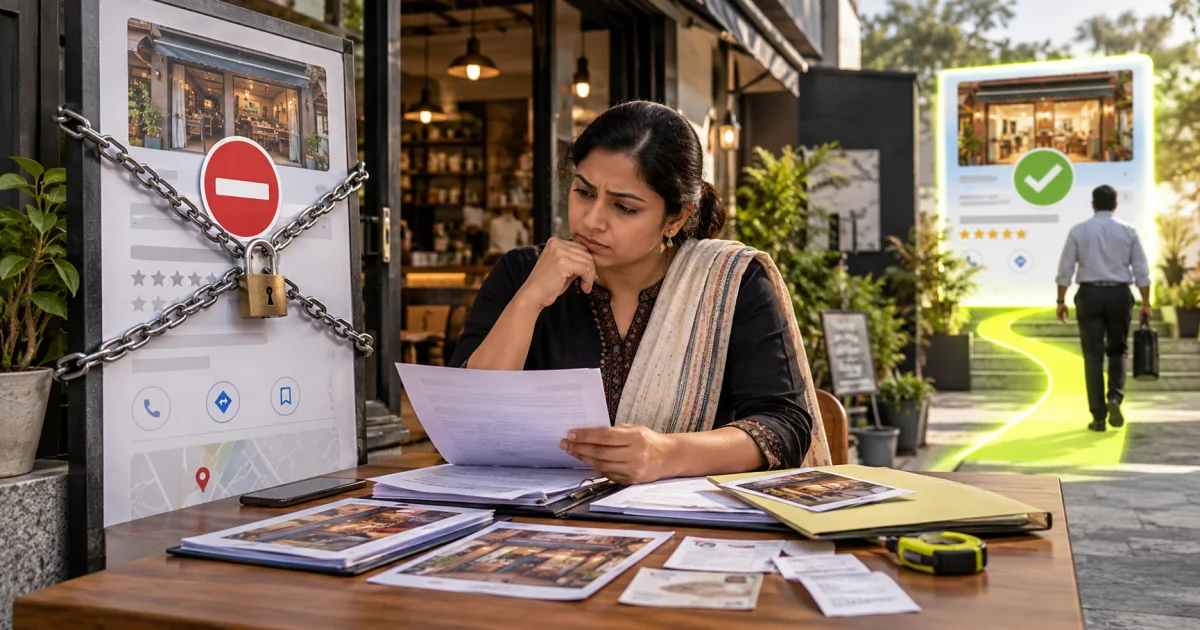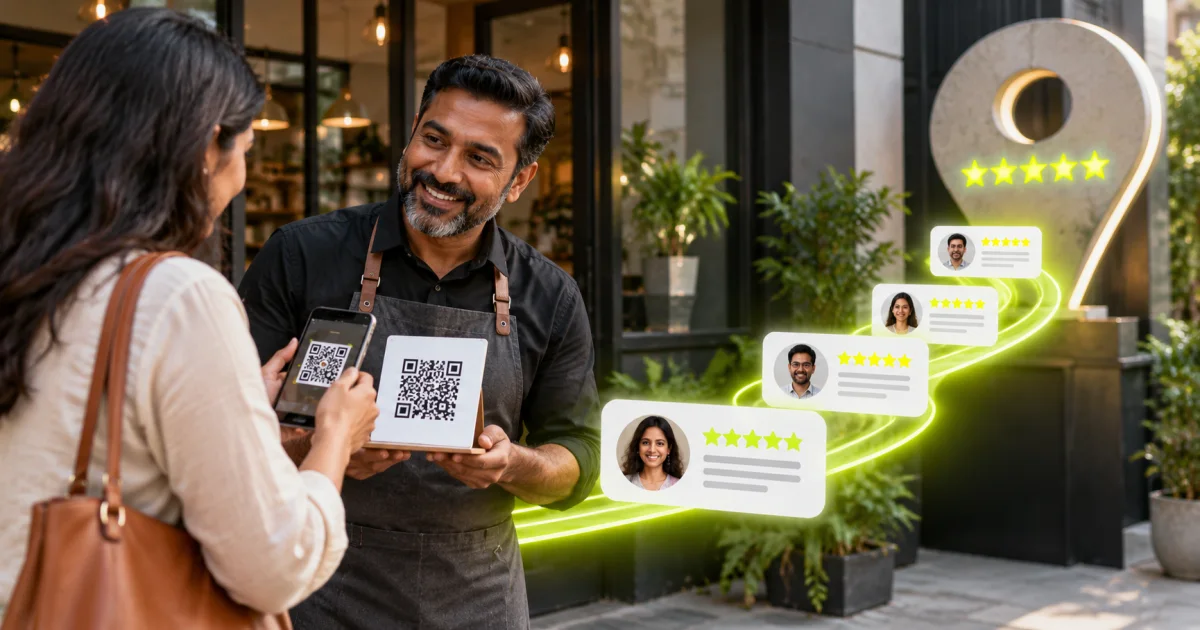
To get more Google reviews, ask customers with a genuine experience to share honest feedback and make the review route easy to use. Follow Google's current policies, avoid incentives or selective pressure and respond professionally. Use feedback to improve the business rather than treating every review as a ranking tactic.
Most businesses do not have a review problem. They have an asking problem. If you are working out how to get more Google reviews, the answer is rarely a clever tactic. It is a fixed habit that runs after every completed job, without anyone having to remember it.
This guide gives you a system you can hand to your team this week: when to ask, how to ask, who asks, and what to do when a one star review lands. It stays inside Google's policies, which matters more than raw volume, because a flagged profile can lose its reviews overnight. If you would rather have the whole thing run for you, that is what our Google Business Profile management work covers.
Why most businesses have fewer reviews than they deserve
Ask an owner how many customers they served well last month and the number is usually large. Ask how many left a review and it collapses. The gap is not unwillingness. It is that nobody asked at the moment the customer felt good about the work.
Three things break the chain. The request goes out days late, once the feeling has faded. It arrives as a long email nobody opens. Or it lands on a staff member who is not sure whether asking is even allowed, so they skip it.
Recency matters as much as the total. A profile collecting a few reviews every month reads as a working business, both to Google and to the person comparing three options on a phone. A pile of reviews that all stopped years ago reads as a business that has moved on. Steady beats spiky.
At RKWS, SEO starts at ₹3,500 per month, digital marketing starts at ₹3,000 per month and Google Business Profile management starts at ₹2,000 per month. Each is a separate scope. Larger catalogues, additional locations and technical repairs require assessment, while paid media spend is separate from management fees.
How to get more Google reviews: the five step system
This takes about an hour to set up and a minute a day to run. It works because it removes decisions. Nobody has to judge whether this customer is the right one or whether today is a good day to ask. If your listing has never been completed properly, fix the listing basics first, because reviews on a half built profile do less work.
- Copy your short review link once. Open your Google Business Profile, use the option to ask for reviews, and save the link in your phone notes and your job sheet template.
- Pick one trigger. Choose the single moment in your process when the customer has just seen the result, and make that the only asking point.
- Name the asker. One role, not the whole team, plus one manager who owns the weekly count.
- Write two lines and freeze them. One WhatsApp message for phones, one sentence staff can say out loud. Nothing longer.
- Check the ratio every week. Count requests sent against reviews received. If only a small share of requests converts, change the timing or the wording before you blame the customers.
Print the same link as a QR code for anything physical: the billing counter, the technician's folder, the back of a visiting card, the table card in a restaurant, which is one part of the wider review and listing routine a cafe should run. Free QR generators handle this fine. Any paid review tool should be checked on the vendor's own pricing page, since that pricing changes often.
When is the right moment to ask for a review?
Ask within a few hours of a delivered result, while the customer can still picture it. The best moment is the handover: the repair works, the order is billed, the report is in their inbox. Ask before the experience becomes routine, and never during a complaint or a pending payment.
The table below maps the moment to the person and the channel. Find the row closest to your business and write it into your process, not into a policy document nobody opens; if you run a gym or a salon, the same timing logic is set out in the review and rebooking routine for local studios.
| Business type | Best moment to ask | Who asks | Channel |
|---|---|---|---|
| Home services such as AC repair, plumbing, pest control | The moment the job is signed off and the customer confirms it works | Technician on site | QR card in hand, WhatsApp link the same evening |
| Retail counter or showroom | At billing, once the fit or the demo has satisfied the customer | Billing staff | Printed QR at the counter plus an SMS link |
| Restaurant or cafe | When the bill is settled and the table is still seated | Steward or floor manager | Table QR card |
| B2B services and agencies | After the first result the client can see in their own reporting | The account manager they work with | WhatsApp or email from a named person |
| Real estate, interiors, civil work | At handover, during the final walkthrough | Project lead | Voice note first, then the link |
Two moments to avoid: while a payment is pending, and while a complaint is open. Asking then reads as pressure, and it invites exactly the review you do not want. Close the issue first, then ask a week later.
Regulated professions need an extra check. If you run a clinic, a dental practice or a legal firm, confirm what your council or bar association allows before soliciting anything from patients or clients, keep personal details out of every public reply, and do not publish patient testimonials on your own site. There is more on those boundaries in our guide to marketing for doctors and clinics.
How should you ask so the customer actually finishes?
Send one short message with the link visible, from a person the customer recognises. Say what the review helps with, keep it to two lines, and attach no conditions. On WhatsApp it takes the customer only a moment to tap through and type two lines. In person, hand over a QR card and stay quiet while they scan it.
A message that works looks like this: "Hi Sanjay, thanks for choosing us today. If the AC is cooling well, two lines on Google help other families in Akurdi find us: [your link]. Ramesh." Named, specific, short, and free of conditions.
- One link, on its own line, not buried inside a paragraph.
- The name of the person who served them, so it does not read as bulk sending.
- A reason that is true, such as helping other people in the area find you.
- No discount, no gift, no "only if you are happy".
- Sent from a number the customer has already spoken to.
- One follow up after two or three days, then stop.
One follow up is enough. If a customer ignores the second message, leave it alone. Chasing a third time costs goodwill worth more than the review.
Who should own review requests in your team?
The person who delivered the work asks, because the customer trusts them. One manager owns the count and reads it out in the weekly meeting. Do not hand the job to marketing, since they were not in the room. Do not spread it across everyone either, because shared jobs quietly become nobody's job.
Make it part of job closure rather than a separate task. The job is not marked complete in your sheet or CRM until the request has gone out, the same way an invoice is not optional. That one change usually does more than any script.
Set a weekly number instead of a monthly target. A handful of requests a day from a small team adds up quickly over a month, and that steady rhythm is exactly what a weekly number protects. If you want the request wired into your CRM or job sheet so it fires without anyone thinking about it, tell us how your jobs close and our team will map it.
Incentives, gating and bought reviews: three fast ways to lose the profile
Google's review policies are not vague here. Offering anything of value in exchange for a review is prohibited, whether that is a discount, a free service, cashback, a gift or entry into a draw. So is review gating, which means surveying customers first and sending only the happy ones to Google. Buying reviews, or having staff, family and friends post them, is the fastest route to trouble.
The penalty is not a polite warning. Reviews get removed in bulk, the profile itself can be suspended, and reinstatement takes documents, patience and weeks you cannot spare. If that has already happened, work through the steps for a suspended profile before you post anything else.
Two habits that look harmless also cause damage. Do not collect reviews on a shop tablet, where every review arrives from the same device and the same network. Do not type the review yourself and hand the customer the phone, because the pattern is visible and the reviews read identically.
The honest version is simpler and safer anyway. Ask everyone, not only the people you expect to be kind. A profile with a few three and four star reviews and thoughtful replies reads as genuine to the next customer, while a wall of identical five star lines looks as if one person wrote them all.
Reply to every review, especially the difficult ones
Replies are public, permanent and read by the next customer choosing between you and two competitors. Set a rule of two business days and give one person the login. A short reply that sounds like a person beats a template pasted under every review.
For a positive review, name the specific thing the customer mentioned and stop there. Three lines is plenty. Do not stuff the reply with your service and city; saying what you did once is natural, saying it five times is not.
For a negative review, work in this order.
- Thank them for the feedback, using their first name if the profile shows it.
- Acknowledge the experience without arguing about the facts in public.
- Say what you have changed or will check, in one specific sentence.
- Move it offline with a name, a number and an invitation to call.
Never reveal what the customer bought, where they live, or anything about a visit if you run a clinic. Never accuse a reviewer of being fake in public, even when you are certain. Flag it through the profile instead, then reply calmly for the benefit of everyone else reading.
Frequently asked questions
How many Google reviews do I need to compete locally?
There is no fixed number. Search your main service and city on a phone, look at the three businesses in the map pack, and note both their count and how recent the newest review is. Match that, then keep going. Nobody can promise a position for any review count, and neither can we.
Can I offer a discount or a small gift for a Google review?
No. Google's policies prohibit incentives of any kind, including discounts, free add ons, cashback and lucky draws. Reviews collected that way can be removed in bulk later, which leaves a business worse off than if it had never collected them.
What should I do about a review I believe is fake?
Flag it through your profile with a short factual note, and reply publicly in a calm tone that accuses nobody, so other readers see your side. Removal is decided by Google and is never guaranteed, so plan on outweighing it with genuine recent reviews.
Do review requests over WhatsApp break any rules?
No. The channel does not matter to Google, but the conditions do. Ask every customer rather than a filtered list, never attach an incentive, and send from a number the customer already knows so the message does not look like bulk marketing.
Make it routine, not a campaign
Review pushes fail because they end. The businesses that pull ahead in local search are the ones where asking is part of closing a job and replying is part of Monday morning. Set the trigger, name the owner, freeze the message, check the count each week.
If you want this built and run alongside the rest of your local search work, our Pune SEO team handles profile management, review systems and reporting from the Akurdi office, for businesses across Pimpri-Chinchwad and Pune and for clients in Vadodara. Send us your profile link and the number of reviews you collected this quarter, and we will tell you what is realistic. Start that conversation with us.
Collecting is half the job — protect the asset with online reputation monitoring for SMBs and own your name results via brand search optimization.