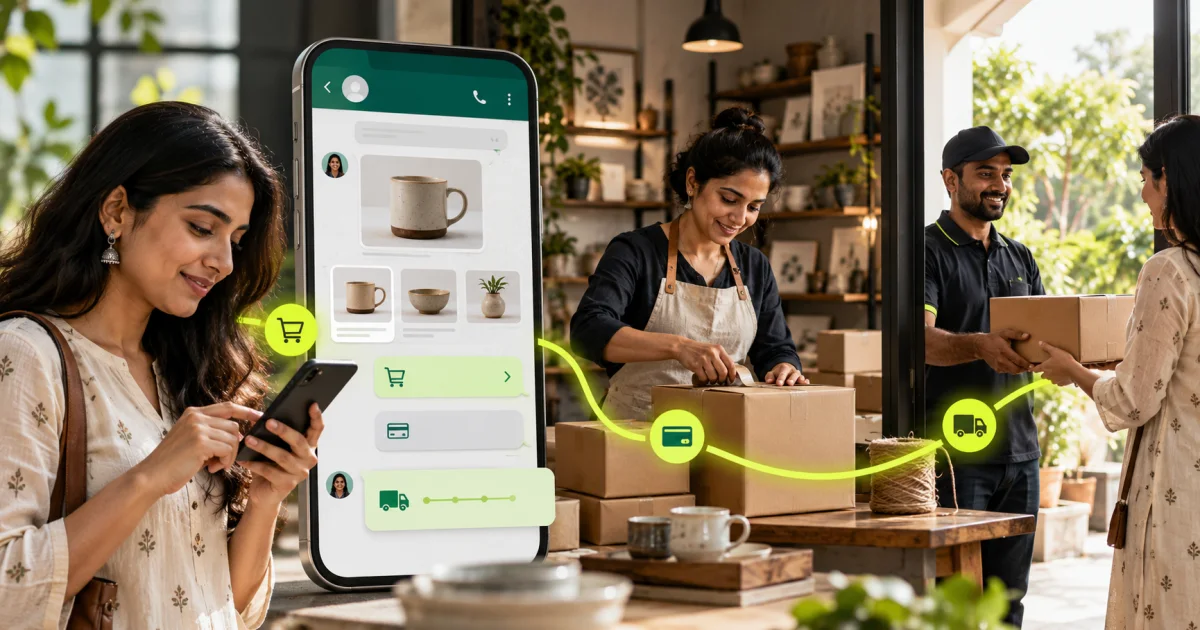
WhatsApp commerce in India uses customer conversations to help people evaluate products, ask questions and complete appropriate buying steps. Keep catalogue details, prices, fulfilment and support responsibilities clear. Use supported tools and current platform policies, obtain appropriate messaging permission and make it easy for a person to handle exceptions.
WhatsApp commerce India has moved well past "price kya hai" and a UPI QR code. Buyers now find a product in an ad, ask three questions in chat, pay through a link, and track delivery in the same thread. That thread is the shop counter. If your digital marketing plan still treats WhatsApp as a support inbox, you are losing orders you already paid to acquire.
This guide walks the full flow, the platform rules that govern it, and the specific places where businesses destroy trust. We build these setups from our Pune office for clients across Maharashtra and Gujarat, so what follows is what we actually implement. Read it as an operations plan, not an inspiration piece.
What does WhatsApp commerce India look like end to end?
A customer sees a click-to-WhatsApp ad or a Google Business Profile chat link, opens a thread, and gets product details with photos and price. They confirm size or variant, receive a payment link, pay by UPI or card, and then get an order confirmation and delivery updates in the same conversation.
Nothing in that sequence asks the customer to open a website, create an account or remember a password. That is the whole advantage, and it is also the risk, because one clumsy broadcast in the same thread gets you blocked permanently.
Discovery is the part that changed most. Industry analyses published in 2026 report that roughly 60 to 63 percent of Google searches end without a click to an external site, which pushes first contact towards ads, listings and chat surfaces rather than web pages. WhatsApp is one of the few places where that first contact can become a paid order in the same session.
| Stage | What the customer does | What you need in place | Where it usually breaks |
|---|---|---|---|
| Discovery | Taps a click-to-WhatsApp ad, a catalogue link or a chat button on your listing | Ad creative that names the product and price band, plus a greeting that references it | A generic "Hi, how can I help?" with no memory of what they tapped |
| Product details | Asks about size, colour, stock and shipping | A published catalogue with clear titles, real prices and one photo per variant | Price only on request, so the buyer leaves to compare elsewhere |
| Payment | Receives and pays a UPI, card or netbanking link | Razorpay or a comparable gateway generating links tied to the order reference | Link sent with no order summary, so the buyer hesitates and stalls |
| Confirmation | Gets an order number and a dispatch expectation | An approved utility template fired by the payment webhook | Manual confirmation typed by a person hours later |
| After sale | Tracks delivery, asks for an invoice or starts a return | Status templates plus a named human on the other end | A bot loop with no visible route to a person |
Setting up the catalogue so the chat can sell
The free WhatsApp Business app carries a catalogue and works well when one or two people manage a small range. You move to the API through a provider once you need automated order updates, several agents on one number, or a link to your CRM. We compare the two tiers in our breakdown of the business app against the API, and picking the tier first saves rebuilding everything later.
- Name each item the way a customer types it, not the way your inventory system stores it, which in tier-2 and tier-3 markets often means the Marathi, Gujarati or Hindi phrasing your buyers actually use.
- Put the real price in the price field. Hiding it starts a negotiation before interest exists.
- Shoot one clean photo per variant against a plain background, because the chat preview is small.
- Write the description as two lines: what it is, and the one detail people always ask about.
- Group items into collections so you can send a link to a section instead of the whole list.
- State GST treatment and shipping charges wherever they change the amount the customer pays.
- Review rejected listings weekly, since catalogue reviews decline items with very little explanation.
Consent and opt-in: the rule that decides everything else
You may only message someone who has given you permission, and that permission has to be traceable. A form checkbox, a start-chat tap, an IVR confirmation or a written reply all qualify, but you need a record of which one, when, and for what type of message. Consent for delivery updates is not consent for marketing.
Store the opt-in source against the phone number in your CRM the same day you collect it. When a quality review lands, that record is your only defence. Honour the opposite just as carefully with a visible way to stop, actioned within one business day. Our note on building WhatsApp automation customers do not block covers sequence design in more depth.
One platform mechanic shapes everything else. After a customer messages you, there is a limited window in which your team can reply freely in ordinary conversation. Once it closes you can only send approved templates until they write again, so design flows around that window rather than fighting it.
How does template message approval work?
You submit a message template with placeholders to Meta through your provider, categorised as marketing, utility or authentication. Review usually returns a decision quickly. Utility templates tied to a real transaction pass easily. Marketing templates that read like a mass promotion, carry vague offers or use unclear placeholders get rejected or downgraded.
Write templates the way a person would write them. Name the customer, name the order, say what happens next, and give exactly one action. Keep a small library: order confirmed, payment received, dispatched, delivered, feedback request, and one seasonal offer template you resubmit whenever the offer changes.
Payments, order confirmation and delivery updates
Payment usually runs as a link rather than an in-chat checkout, and that is a reasonable choice. Razorpay or a comparable gateway generates a link carrying the order reference, and the customer pays by UPI, card or netbanking. The moment the payment webhook fires, your system should send the confirmation template without a human touching it.
Send the order summary and the payment link as two consecutive messages, summary first. The summary is what converts; the link is only the mechanism. For higher value orders, a short voice note from a named person before the link tends to settle nerves.
Cash on delivery still matters across many categories, so do not force prepaid. Lead with the link and keep COD as the option the customer asks for. Confirm every COD order with a template that restates the amount and the address, because unconfirmed COD is where your return rate comes from.
Delivery updates are the easiest win and the most neglected. Wire your courier or order status into the same thread so nobody has to ask "where is my order". If you are still copying tracking numbers by hand, our guide to automating follow-up without sounding automated shows the pattern, and our automation team can connect it to the systems you already run.
Ads feed the top of all this. Click-to-WhatsApp campaigns behave differently from landing page traffic, so they need their own budget line and creative treatment inside your paid campaign plan. If you want an honest read on whether this flow suits your product at all, tell us what you sell and we will say so plainly.
Where must a human take over the chat?
A human takes over when money, exceptions or emotion enter the conversation. That means custom pricing, bulk and B2B enquiries, complaints, refund requests, damaged goods, anything with a legal or medical angle, and any moment the customer asks twice for a person. Every automated flow needs a visible escape hatch.
2026 reporting suggests Meta launched its Business Agent AI across WhatsApp, Messenger and Instagram globally in June, which pushes more of the early conversation onto automated agents. That raises the stakes on handover design rather than removing the need for it. We look at what these agents change for campaign teams in our piece on agentic AI in Indian marketing. Agents that read customer messages can also be steered by them; our guide to prompt injection in AI agents covers how to limit what such an agent can do.
- Hand over after two failed intent matches, not five.
- Put the option to reach a person in the first menu, never three levels down.
- State your working hours in the greeting so nobody waits in silence overnight.
- Pass the full transcript to the agent so the customer never repeats themselves.
- Never let a bot answer a complaint. Acknowledge, then route.
- Give the human a name in the reply, because "Team" is not a person.
What breaks trust and gets your number blocked
Three habits do most of the damage: unsolicited broadcasts to purchased lists, messages with no opt-out, and bot loops that never reach a person. Each produces the same outcome. Block reports rise, your quality rating falls, and your messaging limits shrink. Recovery is slow, and no support queue exists to fix it for you.
There is a quieter failure too. Sending the same offer to your entire list every week trains people to mute you, and a muted thread is worse than no thread because you cannot see it happening. Segment by what people actually bought and when they bought it.
Frequently asked questions
Do I need the WhatsApp Business API, or is the free app enough?
The free app is enough when one person handles a small catalogue and you are content sending confirmations manually. You need the API once you want automated order updates, several agents on one number, or a link to your CRM and billing system. Plenty of sellers start on the app and move across once volume or team size forces the issue.
How much does a WhatsApp commerce setup cost in India?
Indian WhatsApp Business Solution Providers such as AiSensy, Interakt, Wati and Gallabox sit in the region of Rs 1,500 to Rs 5,000 per month, plus WhatsApp's per-conversation charges. Pricing changes often, so check the vendor's current page before you budget. Build and integration work sits on top of that.
Can I message customers who bought from me last year?
Only if you hold a record of their consent and it covers the kind of message you want to send. A past purchase is not automatic marketing consent. Re-permission them through a channel you are already entitled to use, or through an ad that invites them to start the chat themselves.
Will WhatsApp replace my website?
No. Your website is where people compare, read reviews, check policies and find you through search. WhatsApp is where they finish the decision and pay. Drop the website and you lose the discovery layer that fills the chat in the first place, usually without noticing for months.
Start with one flow, not the whole system
Pick your highest volume repeat purchase or your most common enquiry, and build that single flow properly. Catalogue entry, greeting, two qualifying questions, payment link, confirmation template, delivery update, human handover. Run it for a few weeks, read the transcripts yourself, and fix the three questions people keep asking that your flow does not answer.
Then expand. Add a second flow, then broadcast segments built from real purchase history, then integration with billing and inventory. Teams that try to launch everything at once end up with a half-configured system nobody on staff trusts.
If you would rather have this designed and built than assembled from tutorials, we run a Connect, Build, Launch, Optimise process with weekly checkpoints, and campaigns typically go live in two to four weeks. Tell us what you sell, where your orders come from today, and how much chat volume your team can realistically carry. Send us those details and we will reply within one business day.