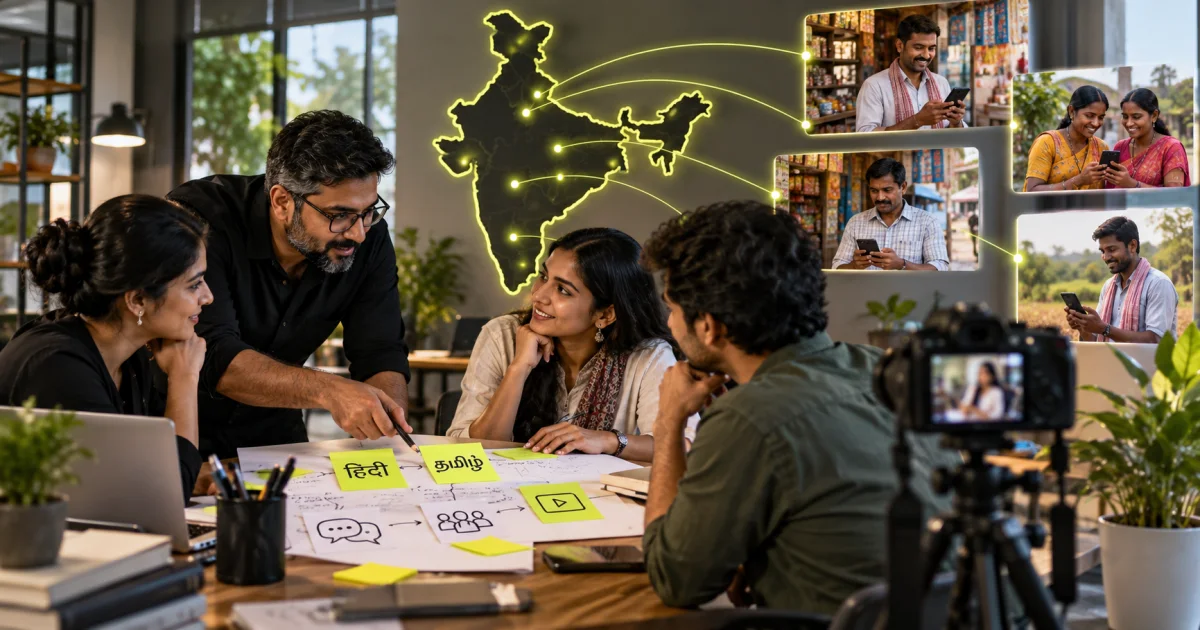
Vernacular content marketing in India means creating useful information in the languages an audience understands and uses for decisions. Choose topics and formats through customer research, then review translations for meaning and local terminology. Keep the offer and factual details consistent while measuring relevant enquiries, not just broader reach.
Your next hundred buyers may not read English comfortably. They search, watch and pay in Marathi, Gujarati or Hindi, often from towns an hour or two outside Pune or Vadodara. English-only content quietly hands those buyers to whoever spoke to them first in their own language.
Vernacular content marketing India gets sold as a translation job. It is not one. It is a decision about which two languages you can keep current for the next three years, how your buyer phrases a question out loud, and which formats survive a weak signal. Our digital marketing work out of Pune treats language as a distribution choice, not a content chore.
Vernacular content marketing India: what it means in practice
It does not mean translating your whole site. It means picking the ten to twenty pages that carry money, rewriting them in the language your buyer thinks in, and keeping them current when prices change. Everything else stays in English until the first language earns its keep.
The test is simple. If a Marathi speaking customer in Chinchwad can find you, understand what you charge, and message you without switching to English, the work is done. If she has to translate your page in her head, she will call the competitor whose WhatsApp message she already understood.
Which languages should a Pune or Vadodara business choose?
Start with Hindi plus one regional language: Marathi if your buyers sit in and around Pune, Gujarati if they sit around Vadodara. Add English for anything technical, price related or B2B. Three languages is the ceiling for most small teams. Two done properly beat six left stale.
Pune buyers skew Marathi with heavy English mixing. Vadodara and the wider Gujarat belt skew Gujarati, and the Hindi you add there serves migrant workforces, transport buyers and enquiries from Rajasthan and Madhya Pradesh. For the businesses we support in Vadodara from our Pune office, Gujarati plus English covers most of the demand, with Hindi added only on specific service pages.
| Language | Where it earns its place | Start with | Watch out for |
|---|---|---|---|
| Marathi | Pune district, Pimpri-Chinchwad, Nashik, Kolhapur and the Solapur belt | Service pages, Google Business Profile posts, short video | Formal written Marathi nobody speaks aloud. Keep the register conversational. |
| Gujarati | Vadodara, Ahmedabad, Surat, Rajkot and the trading networks around them | Product and price pages, WhatsApp catalogues, PDF quotes | Business terms buyers say in English. Do not force a translation. |
| Hindi | Tier-2 and tier-3 towns across MP, UP, Rajasthan and Bihar, plus migrant audiences in both cities | Video, WhatsApp broadcasts, top of funnel answers | Highest competition. Generic Hindi copy ranks badly without local specifics. |
| English | B2B enquiries, technical specifications, pricing tables, anything shared internally | Everything, by default | Assuming it covers the market because your current leads speak it. |
How do people actually speak their search queries?
They speak full sentences, not keywords. A spoken query sounds closer to "Akurdi jawal changla dentist kon aahe" than to "best dentist Akurdi". Most of it arrives in Roman script, mixed with English nouns. Write pages that answer the spoken question in the first two lines.
Two habits matter. Queries carry a location and a qualifier inside the sentence, and they are typed in Roman script far more often than in Devanagari or Gujarati script. So your page needs the transliterated phrasing in the visible copy, not only the native script version. A Vadodara equivalent looks like "Vadodara ma sasti website banavnar kon chhe", and no keyword tool will hand you that phrasing.
2026 reporting suggests roughly 60 to 63 percent of Google searches now end without a click to an external site, and that Google's AI Overviews appear in about 20 percent of searches, rising to around 37 percent in some countries. Conversational, spoken queries are exactly the kind that get answered on the results page. Plan for that the way you would plan for searches that never send a click, and understand what AI Overviews changed for Indian businesses before you write a single vernacular page.
Translation, transliteration and why machine output reads wrong
Three different jobs get confused here. Translation carries the meaning across. Transliteration carries the sound into another script, which is how most Indian users type. Transcreation rewrites the idea so it lands, and that is the one that converts.
Machine translation gets the grammar close and the register wrong. It translates words your buyer says in English, picks the formal pronoun where a shop owner would use the familiar one, and turns a confident offer into a stiff notice. Run the output past a native speaker who has sold something before, not only someone who can read the language.
- Service names translated into words no customer has ever said out loud
- Formal pronouns and honorifics that make a small business sound like a government circular
- English technical nouns forced into local script when everyone types them in Roman
- Numbers, GST wording and units restated so they no longer match your invoice
- Idioms carried across literally, leaving a sentence that is grammatical and meaningless
- Every page moving in the same rhythm, which is what scaled machine output feels like
There is a search risk on top of the reader risk. According to 2026 reporting, Google began rolling out its August 2026 spam update on 18 August, targeting scaled content abuse, expired domain abuse, site reputation abuse and unnatural link schemes, and extended its spam policies to cover attempts to manipulate AI Overviews and AI Mode. Publishing three hundred machine-translated pages in a week fits the pattern that work looks for. Twenty pages a human actually reviewed does not.
How should you structure URLs and hreflang for multiple languages?
Use subfolders on one domain: /mr/ for Marathi, /gu/ for Gujarati, /hi/ for Hindi, English at the root. Keep one URL per language per page. Add hreflang tags to every version, including a self reference and an x-default, and confirm each pair points both ways.
Subdomains and separate country domains are heavier to maintain and rarely worth it for a single-country business. Keep the subfolder, keep the navigation in the language of the page, and never auto-redirect a visitor by IP address. Let people choose their language, then remember the choice.
- Pick the ten to twenty pages that already generate enquiries. Nothing else moves first.
- Write the second-language version from the original brief, not from the finished English page.
- Publish at /mr/, /gu/ or /hi/ using the same page structure as the English version.
- Add hreflang values mr-IN, gu-IN, hi-IN and en-IN, plus a self reference and x-default on each version.
- Translate titles, meta descriptions, image alt text, form labels and thank-you pages, not only body copy.
- Put a visible language switcher in the header that keeps the visitor on the same page.
- List both versions in the sitemap and check indexing coverage after two weeks.
Decide the technical layer before writing starts. Planning the folder structure while the site is being built costs far less than migrating two hundred URLs a year later.
WhatsApp and video carry vernacular further than blog posts
Reading long paragraphs on a mid-range phone over a patchy connection is work. Watching a ninety second video in your own language is not. In tier-2 and tier-3 markets, the same message is easier to take in as a voice note or a short vertical video than as a long article.
- Vertical video, 60 to 90 seconds, with burned-in subtitles so it works on mute
- Voice notes for follow-up, because typing in a regional script is slow for most people
- WhatsApp catalogues and PDF price lists in the local language, easy to forward to a family member
- Google Business Profile posts and review replies written in the language of the review
- One deep service page per language for the searches that still send a click
WhatsApp is where the conversation ends up anyway. Indian solution providers such as AiSensy, Interakt, Wati and Gallabox sit in the region of Rs 1,500 to Rs 5,000 per month plus WhatsApp's own per-conversation charges, though pricing moves and you should check the vendor's current page before you budget. 2026 reporting says Meta launched its Business Agent AI across WhatsApp, Messenger and Instagram globally in June 2026, which makes the language your automated replies use a real decision rather than a setting. Our guide to selling over WhatsApp in India covers the setup end to end.
The Google Business Profile point matters more than it looks. A review reply in Marathi or Gujarati is read by the next buyer scanning your listing, and it signals that you serve people who are not comfortable in English. Treat it as part of your local SEO work across Pune and Vadodara rather than a separate content project.
What does vernacular content cost to run each year?
At RKWS, SEO starts at ₹3,500 per month, digital marketing starts at ₹3,000 per month and Google Business Profile management starts at ₹2,000 per month. Each is a separate scope. Larger catalogues, additional locations and technical repairs require assessment, while paid media spend is separate from management fees.
The recurring cost is maintenance, not creation. Every price revision, new service, festival offer and policy change has to be updated in both languages on the same day. Teams underestimate this and end up with a Marathi section quoting last year's rates, which damages trust more than having no Marathi section at all.
We work in a fixed sequence: connect, build, launch, optimise. Websites take six to twelve weeks, campaigns go live in two to four weeks, and you get a checkpoint every week. If you want a straight answer on whether a second language is worth it in your market, tell us which towns you sell into and we will reply within one business day.
Frequently asked questions
Is Hinglish acceptable, or should we write in pure Marathi or Gujarati?
Write the way your customer speaks. Mixed language is normal in India and reads as natural rather than careless. Keep product and technical nouns in English if that is what buyers say, and keep the sentence structure in the local language. Pure formal prose usually sounds official and distant.
Will Google treat translated pages as duplicate content?
Genuine translations are not duplicates when each version has its own URL and correct hreflang tags. The real risk is scaled, unreviewed machine output, which 2026 reporting connects to Google's work against scaled content abuse. Human review of every published page is the safeguard, and it is not optional.
Do we need a separate Google Business Profile for each language?
No. Keep one profile per real location. You can post updates in more than one language on the same profile and reply to each review in the language it was written in. Creating extra profiles for languages risks suspension and splits your reviews across listings where nobody sees them together.
Can we start with WhatsApp and skip the website pages?
You can start there, and many businesses should. WhatsApp produces conversations quickly and shows you which phrasing works. The gap is discovery, because nobody finds your WhatsApp number through search. Use what you learn in chat to write the first three vernacular service pages once the phrasing is proven.
Two languages, maintained, beat six abandoned
Choose one language beyond English. Take the ten pages that bring enquiries, rewrite them properly, publish them in a clean folder structure with hreflang, and support them with video and WhatsApp. Give it two quarters before you judge the result.
If it works, add the second language. If it does not, you have lost far less than a six language rollout would have cost you. When you want a second opinion on which language your market actually buys in, start a conversation with our Pune team.