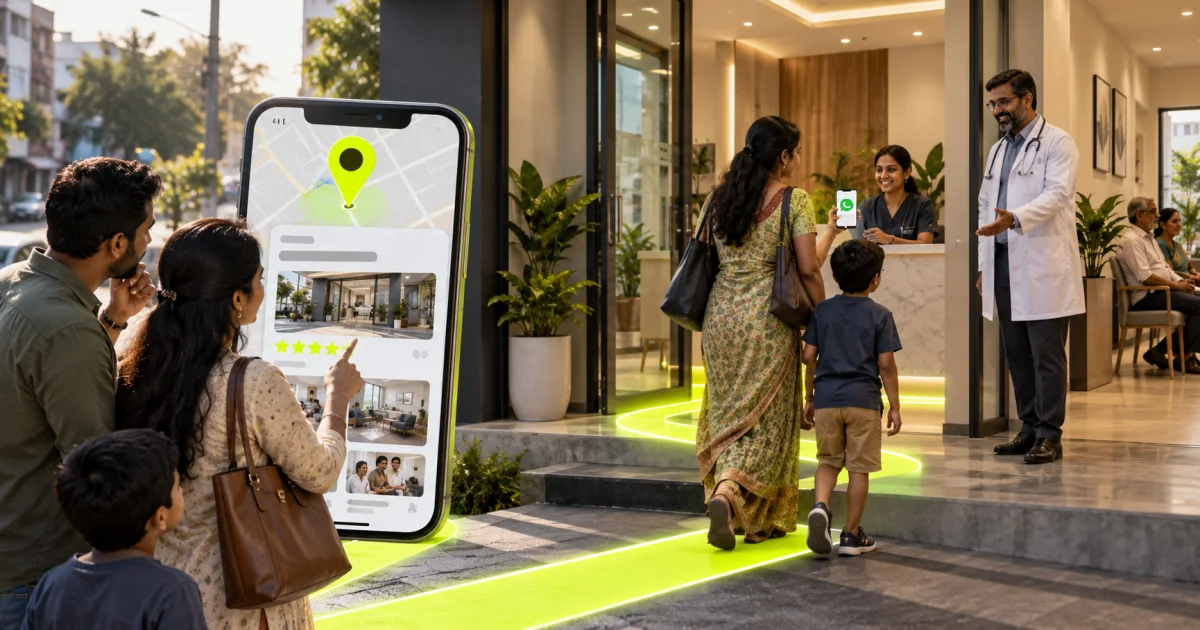
Digital marketing for doctors and clinics should make accurate practitioner, service, location and appointment information easy to find. Keep health-related explanations and outcome claims appropriate and verifiable, and protect patient privacy. Measure relevant appointment enquiries while checking the professional and platform rules that apply to the practice.
Patients rarely start with your clinic name. They open Google Maps, type something like "dentist near me" or "physiotherapist in Akurdi", scan the first three listings, read a few reviews, and call whoever looks open. Digital marketing for doctors and clinics is mostly about winning that short window before the patient picks a clinic.
This guide covers what actually moves appointments: your Google Business Profile, genuine reviews, a website that answers real patient questions, and a booking path that does not depend on someone calling back. We build marketing programmes for clinics in that order, with compliance first, because medical advertising in India is governed by rules that are easy to fall foul of.
How do patients actually choose a clinic?
Proximity, reviews and availability, roughly in that order for most local searches. Most people search on a phone, look at the map results, and shortlist clinics within a few kilometres. They then compare star ratings and read the most recent reviews before calling. If nobody picks up, they call the next clinic.
That sequence has two consequences for your budget. What sits at the top of Google Maps matters more than your homepage design. And an unanswered phone is a lost patient, not a callback.
Search terms are also more specific than most clinic owners assume. People search by symptom, by procedure, by area and by payment method, not by your tagline. Queries like "root canal cost in Chinchwad" or "gynaecologist open on Sunday" are the ones that turn into appointments, and they need profile details and pages that answer them directly.
Your Google Business Profile is the front door
For a clinic, the profile does more work than the website. It decides whether you appear in the map pack for near me searches, and it carries everything a patient checks before dialling: timings, address, distance, photos and reviews. If the profile is thin, the rest of your marketing leaks.
Categories decide which searches you belong in. Pick one accurate primary category such as Dental clinic or Orthopaedic surgeon, add secondary categories only for services you genuinely provide, and list specialisations as service items. Do not stuff keywords into the business name, which is a common reason clinic profiles get suspended.
Hours are the other quiet killer. Publish doctor-wise OPD timings, mark lunch breaks, and set holiday closures in advance. A patient who drives across town to a closed clinic writes the review you will spend months recovering from. Our profile management team handles this monthly for clinics that do not want the admin work.
Work through the basics yourself first. Our field-by-field walkthrough for local service businesses applies almost entirely to a clinic listing.
- One accurate primary category, plus secondary categories only for services you offer
- Business name exactly as it appears on your board, with no added keywords
- Doctor-wise OPD timings, lunch breaks and holiday closures set in advance
- Ten or more real photos: signage, reception, waiting area, equipment, team
- Services listed in plain language patients actually use
- A phone number someone answers during every hour you have published
- A reply to every review within a day, without discussing any patient's case
Reviews are the one input you cannot safely buy. Ask in person after a completed visit, and never offer a discount, gift or free consultation in exchange. Our guide on earning reviews without incentives covers the wording that works and the requests that get listings flagged.
What does digital marketing for doctors and clinics include?
Five things, in order of return: a complete Google Business Profile, a steady flow of genuine reviews, a website that answers common patient questions, a booking path with WhatsApp reminders, and only then paid ads. Many clinics skip the first four and buy ads. That is why the ads disappoint.
Paid advertising deserves a caution here. Google and Meta both restrict healthcare promotion, and several treatment categories are blocked outright or need certification before you can run anything. Ads can fill a new branch or a specific procedure, but they will not fix a two-star profile or a phone nobody answers.
Content is the part that compounds. Pages explaining a procedure, its preparation, its recovery and its typical cost range pull in patients months before they book. Written honestly, they also shorten consultations, because the patient walks in already knowing the basics.
Medical advertising rules you cannot ignore
The National Medical Commission code of ethics restricts how registered practitioners advertise and solicit patients. The Drugs and Magic Remedies (Objectionable Advertisements) Act restricts cure claims for a listed set of conditions. Advertising standards bodies add further rules for health claims, and state councils interpret all of it differently.
Treat this as a hard boundary rather than a grey area. Marketing that brings enquiries and a notice from your council is not a win. Have your own legal advisor read campaign copy, website text and social posts before they go live, and keep a dated record of what you published.
| What you want to show | Compliant approach | Not compliant |
|---|---|---|
| Patient feedback | Unsolicited Google reviews, answered politely and generally | Published patient testimonials, incentivised reviews, replies that reveal clinical details |
| Results | Plain description of a procedure, its preparation and its recovery | Guaranteed outcomes, success percentages, promises that treatment will be painless |
| Standing | Qualifications, registration number, years of practice, hospital affiliations | Best in the city, number one clinic, better than other practitioners |
| Photos | Your own clinic, equipment and team images, used with consent | Before and after images offered as proof, stock photos shown as your clinic |
| Fees and offers | Clear consultation fees, if you choose to publish them | Discount schemes, limited period packages, free treatment giveaways |
The practical test is simple. If a line implies a promise about one patient's result, or positions you above another practitioner, cut it. Describe what you do, who does it, and what a patient can expect procedurally.
A clinic website that answers real patient questions
Most clinic websites list services and stop there. Patients want the boring specifics: consultation fees, which doctor sits on which day, how to reach you, whether parking exists, what documents to carry, how long a procedure takes, and whether cashless is accepted. Answer those and enquiry quality improves immediately.
Speed and mobile behaviour matter more here than visual polish. Someone searching in pain on a patchy mobile connection will not wait for a slideshow to load. Keep the phone number tappable on every screen, put the address and map link near the top, and keep the appointment form to three fields.
Specialty changes the details. A dental practice competes on procedure and cost searches, while a physiotherapy clinic competes on condition and locality searches. If you run a dental practice, the specifics of that market are worth reading before you brief anyone.
The appointment path is where clinics lose money
Everything above produces a call or a message. What happens next decides whether it becomes a visit. Most clinics have no defined path, so enquiries live in a receptionist's memory and a WhatsApp inbox nobody owns.
- Assign one named person per shift to answer the phone, with a second number for overflow
- Offer one alternative to calling: a WhatsApp number, or a three-field form on the website
- Reply to every message within the same working session, with two available slots offered
- Send a booking confirmation containing date, doctor, fee and a map link
- Send one reminder the evening before the appointment
- Follow up a missed appointment once, politely, and then stop
- Record the source of every enquiry so you know which channel is paying for itself
Reminders are the cheapest fix on that list. A confirmation at booking and a reminder the night before cuts no-shows without adding staff time. Setting this up with WhatsApp Business tools takes days rather than months, though your message templates need approval before you can send them.
If you want a second opinion on where your current path leaks, send us your enquiry numbers and we will tell you what stands out. In our experience the gap between calls received and calls answered is often larger than the owner expects.
What should a clinic spend on marketing?
At RKWS, SEO starts at ₹3,500 per month, digital marketing starts at ₹3,000 per month and Google Business Profile management starts at ₹2,000 per month. Each is a separate scope. Larger catalogues, additional locations and technical repairs require assessment, while paid media spend is separate from management fees.
Sequencing beats spending. Fix the profile and the phone first, because they usually cost the least and are the quickest to put right. Build or rebuild the website next, then add reviews and content, and advertise once the basics hold.
On timelines, a clinic website usually takes six to twelve weeks depending on how many doctors, locations and service pages it carries, while campaigns go live in two to four weeks. We run weekly checkpoints so you see progress instead of a monthly report. We do not guarantee rankings. Any agency that does is selling you something it cannot control.
Frequently asked questions
Can a doctor legally advertise a clinic in India?
You can publish factual information: qualifications, registration details, services, timings, fees and location. You cannot solicit patients, promise outcomes, or claim superiority over other practitioners. The National Medical Commission code and the Drugs and Magic Remedies Act set the boundaries, and state councils interpret them differently. Have your own legal advisor review copy before it goes live.
Should we ask patients for Google reviews?
Yes, as long as you ask without incentives and without pressure. Ask after a completed visit, in person or in a plain follow-up message, and let the patient write whatever they want. Never offer a discount, gift or free consultation in exchange, never write reviews yourself, and never republish patient testimonials as marketing material.
How long before a new clinic website brings enquiries?
A clinic website usually takes six to twelve weeks to build. Local visibility then shifts gradually as the profile, pages and reviews mature, and it does not arrive on a fixed date. Anyone quoting a specific ranking or enquiry count for a specific week is guessing. Track calls and form fills weekly so you can see the trend early.
Do we need Google Ads if our profile is already strong?
Not always. If your map visibility is solid and the phone gets answered, ads mainly add reach for a new branch, a new procedure or a crowded locality. Healthcare advertising also carries platform restrictions, so some treatments cannot be promoted at all. Fix the free channels first, then decide whether paid spend has anything left to buy.
Where to start in the next thirty days
Pick the shortest path to a booked appointment. In week one, fix the profile: categories, hours, photos and services. In week two, fix the phone and the WhatsApp path. In weeks three and four, rewrite the three website pages patients actually read.
Then measure one number: enquiries that became visits. Everything else is secondary until that number moves. Our team works with clinics across Pune and Pimpri-Chinchwad, and with practices in Vadodara that we serve from the same Pune office.
If you would rather have a plan than a checklist, tell us about your clinic and we will reply within one business day with what we would fix first and what it would cost. No ranking promises, no lock-in, just the sequence we would follow.