SEO for dental clinics in India should help people find accurate location, appointment and service information and understand what the clinic offers. Keep practitioner details and treatment explanations factual and appropriate. Improve the mobile enquiry journey and measure relevant appointments without inventing clinical outcomes or promising search positions.
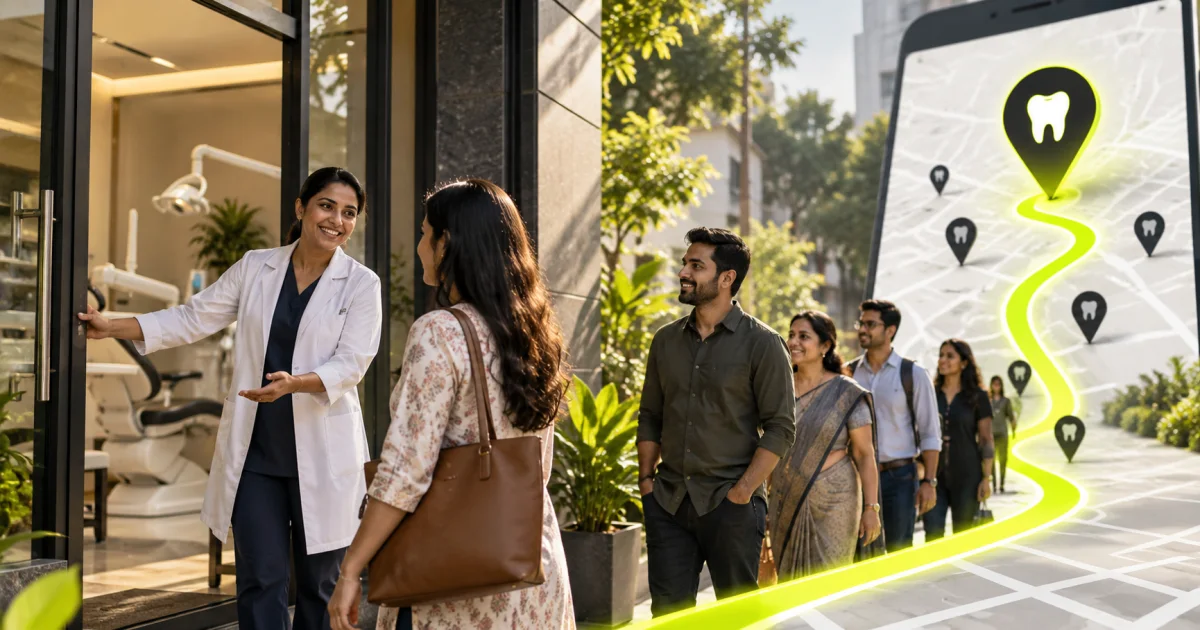
A patient with a cracked tooth at 9 pm does not read your brochure. They open Maps, look at the three clinics closest to them, scan the reviews, and tap call. That behaviour is why SEO for dental clinics India-wide is won street by street, not city by city. Proximity, review history and treatment-specific pages decide who gets that call.
Clinic websites are often built the wrong way round for this. One page lists every treatment, the phone number sits inside an image, and the Google listing still shows the old Sunday timings. Fixing those three things usually moves more appointments than a year of blog posts. This guide covers what we change first, and what our SEO work for clinics can and cannot promise.
Why is SEO for dental clinics India-wide so competitive?
Because dentistry is a high-value, high-frequency local purchase and almost every clinic is chasing the same few streets. Search results are dominated by the map pack, aggregator listings and older clinics with years of reviews. You are not competing on content quality alone. You are competing on proximity, profile completeness and review history.
Dental search also splits into two very different jobs. Someone in pain wants the nearest clinic that is open now. Someone considering implants or aligners researches for weeks, compares clinics across the city, and reads a lot before calling. One website has to serve both without confusing either.
Aggregators make it harder. JustDial, Practo and similar directories occupy the results your clinic wants, and full-time teams optimise them. You will rarely outrank them on a broad city phrase. You can beat them on locality phrases, treatment phrases and the map pack, which is where the booking-ready traffic sits anyway.
Build one page per treatment, not one page for everything
A single services page listing twelve treatments ranks well for none of them. Google needs a page that is clearly about root canal treatment to show for root canal searches. Split them out. One treatment, one URL, one clear next step.
This fixes a commercial problem too. A person searching for braces has different questions, a different budget and a different decision timeline from someone with an abscess at midnight. Separate pages let you write for each of them honestly, instead of turning both into a menu.
Keep the structure identical across every treatment page so the pattern is easy to repeat and easy to maintain.
| Treatment page | What the searcher wants | What belongs on the page | Next step on the page |
|---|---|---|---|
| Root canal treatment | Relief, and to know what the appointment involves | Plain explanation of the procedure, what happens in the chair, aftercare basics, timings, location | Tap-to-call at the top of the page |
| Dental implants | Comparison and cost clarity before committing | Who the treatment suits, the stages involved, what the consultation covers, fee ranges if you publish them | Consultation booking form |
| Braces and clear aligners | To weigh options against work and travel | Difference between the options, the review-visit rhythm, daily care during treatment | WhatsApp Business enquiry |
| Teeth whitening | Quick answers on process and upkeep | What the sitting involves, sensitivity considerations, upkeep at home, who it is not suitable for | Online slot request |
| Dental emergency and tooth pain | The nearest clinic that will see them now | Timings, address with landmarks, parking, direct call link, what to do before arriving | Call button visible without scrolling |
Add the same three trust elements to every treatment page: the dentist name and qualifications, the clinic address with a map, and the timings. Do not add before-and-after galleries of your own patients or written patient stories about their results. That is where dental marketing in India most often crosses a line it does not need to cross.
Link the treatment pages to each other where it genuinely helps the reader, and link each one back to a single locality page for your area. That is how a small site builds a shape Google can read, without hundreds of thin pages.
How does Google pick the three clinics in the map pack?
Relevance, distance and prominence. Distance is measured from where the searcher is standing, so a clinic in Akurdi rarely shows for someone searching in Wakad. You can improve relevance with categories, services and treatment pages, and prominence with reviews and citations. You cannot move the pin.
Proximity caps your reach, and that is the most misunderstood part of local search. A clinic in Akurdi can realistically win searches from Akurdi, Nigdi and the nearby stretch of Pimpri-Chinchwad. It will struggle in Kothrud no matter how good the website is. If you want a second area, you eventually need a second physical location, not more content.
Inside that radius the levers are real. Correct primary category, a complete service list, accurate timings including festival closures, photos genuinely taken at your clinic, and a steady flow of reviews. We go through the map pack mechanics in more depth if you want the full checklist.
Citations still matter for a clinic. Your name, address and phone number should read identically on JustDial, Practo, IndiaMART where relevant, and your own site, down to the shop number and the spelling of the road. Mismatched addresses are one of the quietest causes of weak local visibility.
Treat the profile as a live listing, not a one-time setup
Plenty of clinics fill the Google Business Profile once and never open it again. Then a competitor suggests an edit, the category shifts, the timings drift after a holiday week, and calls quietly drop. Someone has to own it.
A weekly pass is enough. Check the timings, reply to every review, answer questions in the public questions section before a stranger answers them for you, and post the occasional update about a new facility or a change in schedule. When we run profile management for a clinic, that maintenance rhythm is most of the work.
Photos carry more weight here than on the website. Reception, the chair, the sterilisation area, parking, and the building as it looks from the road. People are deciding whether the place looks clean and whether they will find it on a busy lane.
How do you get more reviews without breaking medical advertising rules?
Ask every patient at the desk, in person, on the day, and make it one tap through a QR code or a WhatsApp link. Never script the wording, never offer a discount for a review, and never publish patient stories as treatment testimonials. Ask about the visit, not the outcome.
Print a QR code that opens your review link directly and keep it at the billing desk. Have the front desk ask while the patient is settling the bill, not by SMS three days later. A WhatsApp Business message the same evening works as a second nudge.
Two rules matter more than the rest, and your own compliance advisor should confirm them for your practice. Do not incentivise reviews in any form, and do not solicit or publish comments about treatment results, comparisons with other dentists, or anything that reads as a cure claim. Dental practice advertising in India sits under professional conduct rules that change from time to time, so confirm the current position with your council guidance or your own advisor before you launch anything. A fuller process for asking patients for reviews is worth reading first.
Reply to every review, positive and negative. Keep replies short and generic. Never confirm that someone was a patient, never discuss their treatment in public, and never argue in the thread. Thank them, note the concern, and move the conversation to a phone number.
If you are not sure whether your current review process is compliant, tell us about your practice and we will go through it with you.
Answer the questions patients type before they book
Treatment pages capture people who already know what they need. A large share of dental search is people trying to work out what is wrong and what it will cost them in time, money and days off work. They are usually less contested, because plenty of clinics ignore them completely.
Write short, specific pages that answer one question each, in plain language, using the words patients actually type.
- What happens during a root canal appointment, step by step
- How to tell everyday sensitivity from a cavity that needs treatment
- What a dental implant consultation covers before any work begins
- Whether braces or aligners suit an adult with a full work schedule
- What to do at home when a tooth breaks late at night
- How to check what your insurance or corporate plan covers before booking
Keep the answers honest and unglamorous. No promises about results, no claim that your clinic is the best in the city, no numbers you cannot support. Clarity is what earns the call, and it also keeps you on the right side of the rules.
Content written this way also holds up in AI answers and chat-based search, because the text plainly answers the question that was asked.
The booking path on mobile decides whether rankings pay
Ranking well and converting badly is the most expensive failure in local search. Assume this traffic arrives on a phone, often on a patchy connection, often one-handed and in a hurry. If the number is not tappable on the first screen, you are paying to send appointments to the clinic down the road.
Fix the path in this order.
- Put a tap-to-call link in the header of every page, as real text, never inside an image.
- Add a WhatsApp Business link beside it, because plenty of patients will not call a stranger first.
- Cut the enquiry form to name, phone, treatment and preferred time, and nothing else.
- Show timings, address and a map link on every treatment page, not only on the contact page.
- Make pages load quickly on a mid-range Android phone running on mobile data.
- Answer every enquiry inside business hours and log who followed up.
Speed and structure are website work rather than SEO tweaks, which is why we usually pair the two. A clinic site rebuilt properly takes six to twelve weeks with us, and campaigns typically go live in two to four weeks while the build continues. If the site is the bottleneck, the build itself is where your money should go first.
Then track calls, not only rankings. A clinic that ranks third and answers every call beats one that ranks first and lets the phone ring out. Keep a simple record of enquiry source, treatment asked for, and whether the appointment actually happened. Our wider view of marketing for clinics and doctors covers the rest of that picture.
Frequently asked questions
How much does dental SEO cost in India?
At RKWS, SEO starts at ₹3,500 per month, digital marketing starts at ₹3,000 per month and Google Business Profile management starts at ₹2,000 per month. Each is a separate scope. Larger catalogues, additional locations and technical repairs require assessment, while paid media spend is separate from management fees.
How long before a dental clinic sees results from SEO?
We do not guarantee rankings and we will not put a date on them. What we do commit to is the working rhythm: weekly checkpoints, a reply within one business day, and visible progress on the profile, the treatment pages and review flow well before rankings settle. Map pack movement usually shows earlier than competitive treatment phrases.
Can a clinic rank in an area where it has no branch?
Not in the map pack. Distance from the searcher is a hard input, so a listing will not be pulled into an area where the clinic does not physically sit. You can still rank in the standard results with a locality page, and that does bring enquiries, but it rarely matches a clinic with an address in that area.
Is it safe to publish patient before-and-after photos?
Treat it as a no unless your own compliance advisor tells you otherwise in writing. Dental advertising in India is governed by professional conduct rules, and result imagery, testimonials and superiority claims are the usual flashpoints. Clinical photography kept for records is a different thing from marketing material on a public page.
Start with the three moves that pay soonest
If you do nothing else this month, do these in order. Claim and correct the Google Business Profile, including categories, timings and photos. Build the two treatment pages that carry your highest-value work. Put a tappable phone number and a WhatsApp link on every page.
Everything else in this guide compounds on top of those three. It is unglamorous work, and it is exactly why a clinic that stays consistent for a year becomes very hard for a newer practice on the same street to displace.
RadhaKrishna Web Solutions supports businesses in Pune, Maharashtra, and Vadodara, Gujarat, through remote project delivery. We do not currently operate a customer-facing office. Contact the RKWS team to discuss your requirements and agree the next steps.