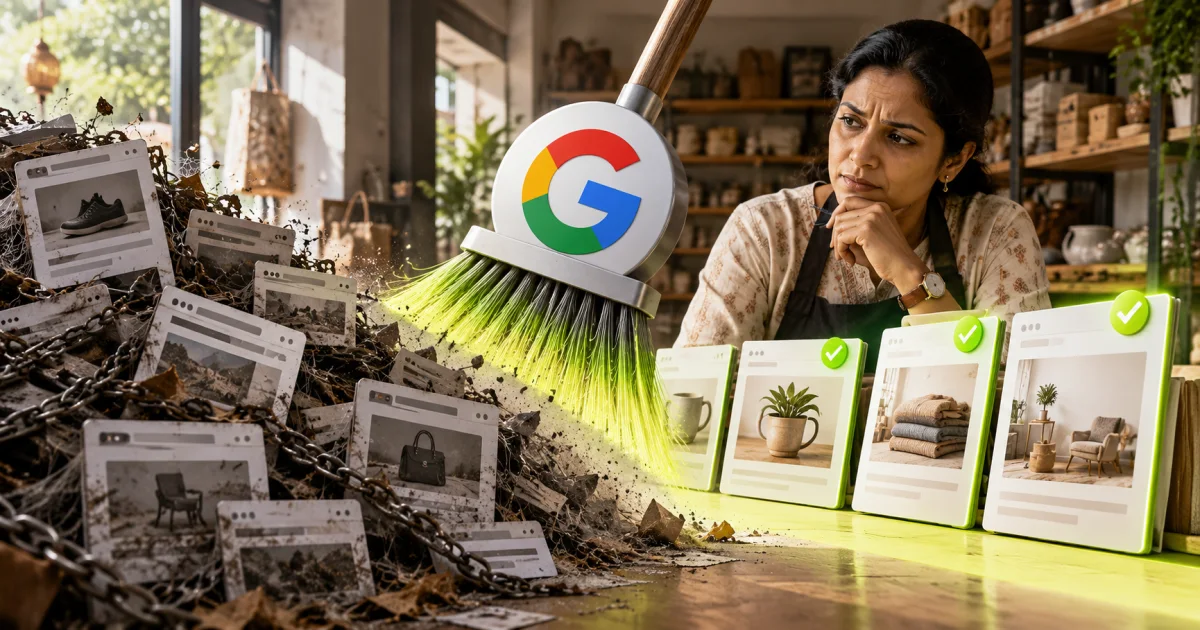
Ecommerce SEO in India helps customers find and evaluate relevant products through clear categories, useful product pages and an accessible purchase journey. Review crawlability, variants, internal links, product information and structured data. Keep stock, delivery and pricing information accurate, then measure qualified product visits and completed transactions.
Plenty of ecommerce sites in India rank for their own brand name and very little else. The catalogue is live, UPI and Razorpay are working, the WhatsApp button sits on every page, and organic traffic still stays flat month after month. Ecommerce SEO in India usually fails for one predictable reason: the store was built as a shop, not as a set of pages that answer searches.
Product pages get all the attention. Category pages, which are the pages that actually pull traffic, get a heading and a grid. If you want the wider view of how search work is scoped and run, our approach to SEO covers that ground. This article stays narrow: architecture, product uniqueness, filters, stock, schema, speed, and where marketplaces leave you room.
What makes ecommerce SEO in India different from service-business SEO?
Service-business SEO wins with a few strong pages and local signals. Ecommerce SEO is an inventory problem. You are managing thousands of URLs, duplicate manufacturer copy, filters that spawn endless combinations, and products that go out of stock. The work is architecture and crawl control before it is content.
Three things follow from that. Search engines have a finite appetite for your site, so every sort order and filter combination you let them crawl is a crawl you did not spend on a product. Your competitors include marketplaces with authority you will not match. And your pages change constantly, because prices move and stock runs out.
Category pages are your biggest ranking asset
Head and mid-tail demand lands on category pages. Someone searching for cotton bedsheets or industrial safety shoes does not want one SKU, they want a shortlist. The page that satisfies that intent is a category page with a clean grid, useful filters and enough context to help a buyer choose.
Build the category tree from search demand, not from your warehouse structure. If a phrase gets searched and you only hold it as an internal tag, it deserves a real URL with its own title, heading, copy and internal links. If nobody searches a category, it does not need to be indexable at all.
A category page that ranks usually carries a short block of text above the grid, a longer buying guide below it, links to sibling and child categories, and a title and description written for that category alone. Thin category pages are a gap we see again and again on Indian stores.
Pagination deserves its own decision. Keep page two onward crawlable and give every paginated URL a self-referencing canonical. Canonicalising all pages back to page one is the fastest way to hide half your catalogue. If you use infinite scroll, back it with real paginated URLs underneath.
Match the page type to the intent before you write a word.
| Search example | Intent | Right landing page | What the page must do |
|---|---|---|---|
| cotton bedsheets king size | Browsing a range | Category page | Show breadth, filters, price sorting, buying guidance |
| brand name plus model number | Ready to buy a known item | Product page | Price, stock, delivery, warranty, trust signals |
| best water purifier for hard water | Problem-led research | Buying guide linked to a category | Explain the trade-offs, then link to matching products |
| buy safety shoes online | Transactional, no brand in mind | Category page | Fast load, clear pricing, easy filtering |
| brand name plus model number review | Evaluating before purchase | Product page with real reviews | Genuine reviews, full specs, answered questions |
How do you fix product pages built on manufacturer descriptions?
You cannot outrank a marketplace using the same paragraph the manufacturer sent to every seller. Add what only a seller knows: fitment notes, what is in the box, sizing that runs small, service and warranty terms, GST invoice details, and your own photographs. A short honest description beats a long spun one.
You will not rewrite three thousand products this quarter, so prioritise. Start with products already picking up impressions in Search Console, then your highest-margin lines, then anything with a variant problem. Leave the long tail of low-value SKUs on template copy, and keep them out of the index if they add nothing.
Useful additions to a product page, in rough order of return:
- Compatibility and fitment notes that stop returns before they happen
- Exact contents of the box, materials, and honest sizing guidance
- Warranty, service network, GST invoice and return terms in plain words
- Delivery expectations by region, including where you cannot ship
- Real customer questions answered on the page, not hidden in a chat widget
- Your own photographs and short video, not the supplier's stock set
Decide once how variants behave. If people search for the colour or the size, give that variant its own URL and its own copy. If they do not, keep a single canonical product URL and switch variants on the page. Doing both creates duplicates that compete with each other.
Faceted navigation is where crawl budget goes to die
Filters multiply fast. Four colours, five sizes, three price bands and eight brands is not twenty pages, it is hundreds of near-identical URLs, and each one can be crawled, indexed, or both. Left alone, this becomes one of the heaviest technical problems on a large Indian catalogue.
The fix is a set of deliberate decisions, made once and enforced in the template:
- Pick the facets with real search demand, usually brand and one attribute, and give those clean indexable URLs
- Disallow the facet patterns you never want crawled at all in robots.txt
- For facet URLs already indexed, keep them crawlable and add noindex until they drop out
- Never let sort order, page size, session or campaign parameters create indexable URLs
- Cap how many facets can combine at once, and stop linking beyond that cap
- Watch Search Console for spikes in "Discovered, currently not indexed"
- Read server logs to see where Googlebot actually spends its time on your site
Store owners rarely see this, because it does not show in the storefront. It shows in log files and coverage reports. If your catalogue is large and traffic has stalled without an obvious cause, send us the site and we will tell you what the crawl data says.
What should you do with out-of-stock and discontinued products?
Do not delete the URL and do not let it 404. If the product is coming back, keep the page live, mark availability correctly, and offer alternatives with a WhatsApp or email notify option. If it is gone for good, redirect to the closest matching product, or to its category page.
Blanket redirects to the homepage do not work. Google treats them as soft 404s, and you lose whatever links and history that URL had earned. Seasonal stock is the clearest case: a product that returns every winter should keep its URL, its reviews and its rankings all year.
Keep the availability value in your structured data matched to what the page actually shows. A page that says in stock in the markup and sold out on screen is a mismatch that costs you eligibility in merchant surfaces, and it wastes the click you paid for in trust.
Schema, internal links and speed on a big catalogue
These three run together, because each of them decides whether a product deep in your catalogue ever gets found. The general rules still apply, and our wider technical checklist covers the shared ground. What follows is what changes at catalogue scale.
Product schema
Mark up every product with Product and a nested Offer carrying price, priceCurrency in INR, availability and condition. Add brand, SKU and GTIN where you have them, and BreadcrumbList on category and product pages. Use AggregateRating and Review only where genuine reviews sit on the page.
Schema does not improve rankings by itself. It changes how your listing can appear and whether you qualify for merchant experiences, which is worth having, but it will not rescue a thin page. Invalid markup is worse than none, so validate after every theme or plugin update.
Internal linking from category to product
A product on page fourteen of a category receives almost no internal links, so it gets crawled rarely and ranks poorly. Fix that with curated modules on category pages, related products chosen by attribute rather than at random, breadcrumbs on every page, and buying guides that link down into specific products.
Speed with thousands of URLs
Do not lazy load the largest image above the fold, serve modern image formats, and cut the number of third-party scripts fighting for the main thread. Chat widgets, heatmaps and duplicate pixels are usually the worst offenders. We go deeper in a guide to site speed.
Platform is not destiny. Neither Shopify nor WooCommerce is fast or slow by default; the theme, the apps and the image pipeline decide it, and we set out the trade-offs in a platform comparison for Indian stores.
If your theme cannot be made fast without a fight every release, a rebuild on a cleaner stack may be cheaper over two years. Plan six to twelve weeks for it, and schedule it well away from your peak season rather than during it.
Marketplaces will outrank you on brand terms, and that is fine
Marketplaces can help buyers discover suppliers, but they also place competing businesses side by side. Keep useful listings while building your own capability pages and enquiry process, so you can compare qualified requests from each channel rather than relying on marketplace reach alone.
So stop fighting there and take what is winnable: category terms, problem-led long tail, attribute combinations that marketplaces handle badly, and your own brand terms, which you should defend properly. That is where a specialist store beats a general one, because you can write with knowledge a marketplace listing does not have.
The zero-click shift matters here too. Published 2026 analyses suggest Google AI Overviews appear in roughly 20 percent of searches, and that about 60 to 63 percent of Google searches end without a click. Informational queries lose the most, while buying queries still send people to a page where they can check price, stock and delivery. We covered what AI Overviews change for Indian businesses separately.
One honest note. We do not guarantee rankings, and no agency can. Search results move for reasons nobody controls, so what we commit to is the work, the sequence and the reporting.
Frequently asked questions
How long does ecommerce SEO take to show results?
Technical fixes land quickly. Crawl control, schema and speed work usually ships within the first few weeks, and index changes follow soon after. Category rankings and revenue move slower, typically over several months, depending on competition and how much of your catalogue needs rebuilding. We run weekly checkpoints so progress stays visible.
What does ecommerce SEO cost in India?
At RKWS, SEO starts at ₹3,500 per month, digital marketing starts at ₹3,000 per month and Google Business Profile management starts at ₹2,000 per month. Each is a separate scope. Larger catalogues, additional locations and technical repairs require assessment, while paid media spend is separate from management fees.
Do I need unique descriptions for every product?
No. Prioritise by revenue and existing impressions. Rewrite your top sellers, your highest-margin lines and anything already close to page one. Products with no search demand can stay on template copy, and if they add nothing at all, keep them out of the index rather than pretending they are pages.
Should I run Google Ads while SEO builds?
For most stores, yes. Search work on a large catalogue takes months, and paid shopping traffic keeps revenue moving meanwhile. Treat the two as one plan: use paid search query data to decide which categories deserve SEO effort first, instead of guessing from a keyword tool.
Where to start on your catalogue
Sequence matters more than effort. Writing content before crawl control means you build pages Google will not reach. Work in this order:
- Audit crawl and index coverage, then close the facet and parameter leaks
- Fix pagination, canonicals and breadcrumbs across the templates
- Rebuild the category tree around search demand and write real category pages
- Rewrite product pages in priority order and settle your variant rule
- Add Product and BreadcrumbList schema, then validate it
- Work on speed and internal links, and set a stock-change policy that holds
RadhaKrishna Web Solutions supports businesses in Pune, Maharashtra, and Vadodara, Gujarat, through remote project delivery. We do not currently operate a customer-facing office. Contact the RKWS team to discuss your requirements and agree the next steps.
If you sell online and your product pages are not being found, send us your URL, your top three categories and your budget band. We reply within one business day, and the first conversation is about what we would fix first and in what order. Tell us about your store and we will take a look.