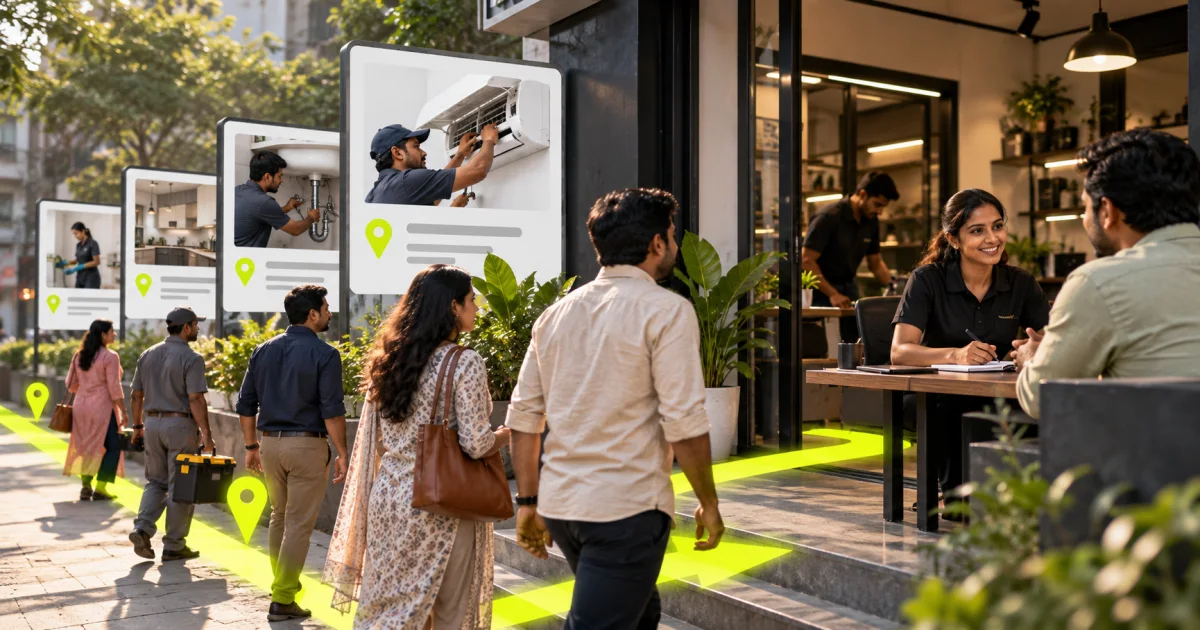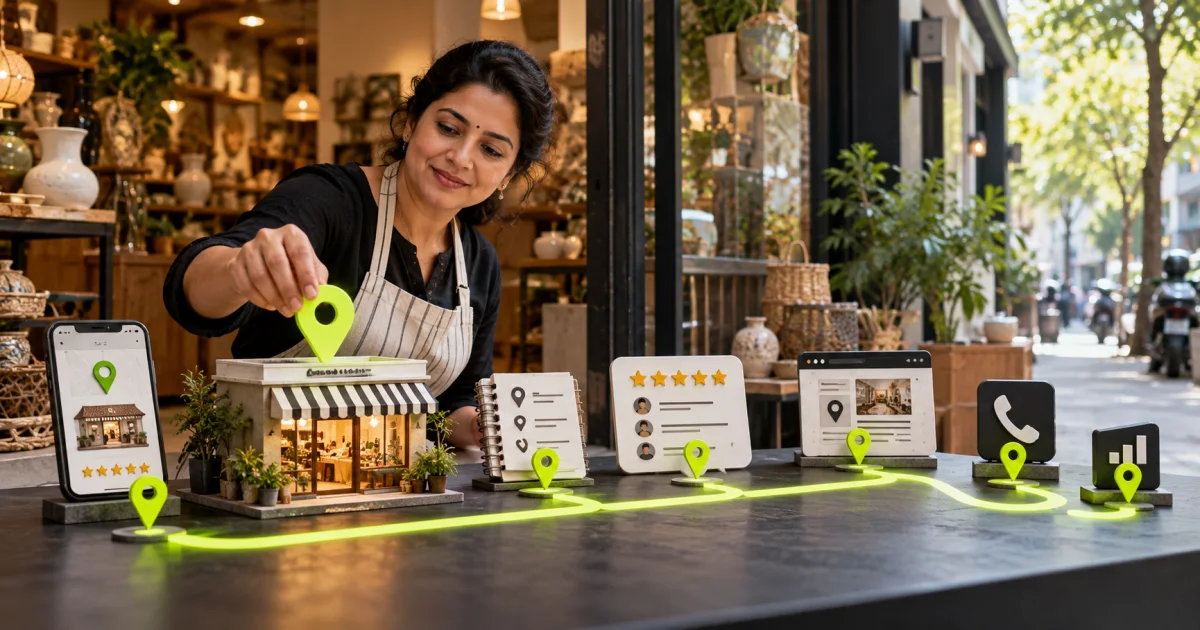
A local SEO checklist for Indian businesses should cover accurate website information, eligible Business Profile details, relevant service pages, reviews and a reliable mobile enquiry experience. Check consistency across official listings and measure useful local demand. Visibility depends on multiple factors, so no checklist can guarantee a map position.
Plenty of local businesses in India lose search visibility for boring reasons: a wrong primary category on Google, a phone number that differs across directories, a homepage that crawls on a 4G phone. None of it is hard to fix. This local SEO checklist covers the work that actually moves calls and walk-ins for a shop, clinic, showroom, coaching centre chasing an admission season or service business.
One warning before you start editing: changing your business name, address and category all at once can trigger a suspension. If that has already happened, see our guide to getting a suspended Google Business Profile reinstated.
Work through it in order instead of cherry-picking. Start with the Google Business Profile management basics, because that listing is usually where local searchers first encounter a business. Everything after it either supports that listing or gives Google more reason to trust what it says.
What does a local SEO checklist actually cover?
A local SEO checklist covers seven areas: your Google Business Profile, name and address and phone consistency across Indian directories, city and service pages on your own site, review generation, local schema markup, mobile page speed, and lead tracking. Skip one and the others work harder for less return.
The sequence matters more than owners expect. A well-built website will not outrank a competitor whose Google listing has hundreds of genuine reviews and the correct primary category. Fix the listing, then the site, then the citations, then the measurement.
One caution before you start. Local rankings shift with the searcher's exact location, so two people in different parts of the same city can see different results for the same query. Judge progress by calls, direction requests and form fills rather than by what you see on your own phone. Our explainer on how the map pack picks winners goes into that geography in more detail.
Claim the Google Business Profile and set the categories properly
This is the highest-return hour you will spend. We regularly open listings with a plausible-looking category that quietly costs the business visibility, because the owner picked what the business calls itself rather than what customers type into Google.
- Claim or request ownership of the listing. If someone else controls it, use the ownership request flow and wait out the response window instead of creating a duplicate.
- Set one primary category that matches what you actually sell. Dental clinic and dentist behave differently in search results, so choose the term your customers use.
- Add secondary categories only for services you genuinely deliver. Three or four is usually enough.
- Enter the address exactly as India Post would write it, pin code included. Set a service area if you travel to customers instead of receiving them.
- Use a real local number that someone answers. If you add a call tracking number, keep your main published number in the additional phone field so it still matches your other listings.
- Fill in regular hours, holiday hours, payment options such as UPI and card, and the services list using your actual service names.
- Upload photos of the real premises, team and finished work. Exterior shots help people recognise your place from the road.
After the basics, use the parts of the profile most businesses ignore. Answer the questions in the Q and A section yourself, because unanswered questions get answered by strangers. Post an update once or twice a month with a real offer or a completed job. Turn on messaging only if someone will actually reply within a business day.
Why does NAP consistency matter so much in India?
Because Indian listings get created without you. Directories scrape data, sales teams add entries to hit targets, and old numbers survive for years. When Google finds three versions of your address, it trusts each one a little less. Cleaning up duplicates is unglamorous work that quietly lifts local visibility.
Start with a simple audit. Search your business name plus your city in Google, then your old phone number in quotes, then your address without the business name. Write down every listing you find, including the ones you did not create. Most owners are surprised by how many exist.
Then fix them in priority order. The table below covers the sources that actually influence Indian local search, rather than the hundred-citation packages sold by cheap vendors.
| Source | Why it matters in India | What to get right |
|---|---|---|
| Google Business Profile | Feeds the map pack and almost every near me search. For many local businesses it is the main source of enquiries that come from search. | Primary category, exact address with pin code, real local phone number, hours, full services list. |
| JustDial | Still a first stop for many buyers, and it often ranks for searches on your own brand name. | Claim the free listing, match name and address and phone exactly, remove duplicates created by sales agents. |
| IndiaMART | Dominant for B2B, manufacturing, industrial supply and wholesale enquiries. | Correct GST details, product categories that match your real catalogue, a single company profile. |
| Sulekha | Useful for home services, tuition, repairs and event vendors in the metros. | Consistent business name and a service area that matches the one on your Google listing. |
| Bing Places and Apple Business Connect | Feed Apple Maps, Siri and Windows search. A small share of traffic for close to zero effort. | Import from Google where the option exists, then verify phone and hours by hand. |
Ignore anyone offering bulk citation packages at throwaway prices. Those links sit on dead directories, often with mangled addresses, and they create more cleanup work than they are worth.
Build location pages that earn their keep
If you serve more than one area, you need pages for those areas. The test is simple: could this page have been written by someone who has never visited the place? If yes, it will not rank and it will not convert.
A location page that works names the specific localities you cover, the landmarks people use for directions, the timings for that branch, and the services that branch actually offers, and property developers face the same test on project pages that answer the full buyer question set. Add photos of that location. Add the parking situation if parking is a problem in that area, because it is a real question buyers have.
Do not spin thirty near-identical pages for thirty pin codes. Google's own guidance treats that pattern as doorway pages, and it dilutes the pages that deserve to rank. Two strong pages beat twenty thin ones. If you operate across cities, our team's notes on local search in Pune and Vadodara show how the same structure adapts across markets, and the same principles guide the work our Pune search team runs for multi-branch clients.
How do you get more reviews without breaking the rules?
Ask every customer, at the moment the work is finished, using a short link, though firms bound by ICAI or Bar Council rules should confirm their council's position before asking at all. That is the entire method. Google's policy bans incentives, so no discounts, no free service and no lucky draws in exchange for a review. Gating, where you only invite the customers you expect to be happy, breaks the rules too.
- Ask in person when the job is done and the customer is visibly satisfied.
- Send the short Google review link over WhatsApp within an hour of the visit.
- Print the link as a QR code at the billing counter or on the invoice.
- Make one person responsible for asking. Shared responsibility means nobody asks.
- Ask everyone, not only the customers you assume will praise you.
- Reply to every review within one business day, including the one-star ones.
Bought reviews are a bad trade. They arrive in bursts from accounts with no history, Google filters a good share of them, and a suspended profile costs you weeks of enquiries while you appeal. A steady trickle of genuine reviews with real detail in them is worth more anyway, because buyers read the text, not the star average alone.
Handle negative reviews in public and resolve them in private. A calm, specific reply that offers a phone number does more for the next reader than the complaint does against you. If you want a second pair of eyes on your review flow before you build it, send us the details and we will tell you what we would change.
Local schema, mobile speed and the technical floor
None of this wins on its own. All of it loses for you when it is missing, which is why we treat it as a floor rather than a strategy. Local sites we open on a mid-range Android phone routinely miss several of the items below.
- LocalBusiness schema on the homepage and on every location page, using the same name, address and phone as the Google listing.
- A tap-to-call link near the top on mobile, as real text, not a phone number baked into an image.
- Largest Contentful Paint under 2.5 seconds on a mid-range phone over 4G, not on your office broadband.
- Compressed images in WebP, lazy loading below the fold, and no heavy slider in the hero.
- An embedded map on the contact page with the address and pin code also present as text.
- One canonical version of the domain on HTTPS, with no duplicate city pages competing against each other.
Schema is the item most often done badly. Copying a snippet from a blog and leaving the sample address in place is common, and it tells search engines the wrong thing about you. Our guide to marking up business details for search engines covers the fields that matter, and the write-up on fixing slow pages deals with the speed side.
Track calls, WhatsApp chats and direction requests
Local SEO produces phone calls and WhatsApp messages, not neat form submissions. If your only measurement is a contact form, you will conclude that local search does not work for you, and you will be wrong.
Track four things at minimum: calls from the Google listing, which the profile reports natively, and direction requests, which usually come from someone close to visiting. Add clicks on your site's tap-to-call link as an event in analytics. Then tag the WhatsApp link on your site with a source parameter, so a chat started from search is distinguishable from one started at an Instagram bio.
Then compare month to month, not week to week. Local search moves slowly and seasonally, and a bad week means nothing. Reviews arriving, categories corrected, duplicates removed and pages loading faster are the inputs you control, and the enquiry count is the output you watch over a quarter or two. That is how the search work our team does is measured, and it is why we do not guarantee rankings to anyone.
Frequently asked questions
How long does local SEO take to show results?
Profile fixes such as categories, hours and photos can shift visibility within a few weeks. Citation cleanup and review growth take longer, usually a quarter before the pattern is clear. Competitive categories in large cities take longer still. Anyone promising results in thirty days is guessing.
Do I need a physical office to rank in local search?
You need a real address that you can verify, but you can hide it and show a service area instead if you visit customers rather than receiving them. Virtual offices and coworking desks used purely for verification are against Google's guidelines and get listings suspended.
Can I use a call tracking number on my Google Business Profile?
Yes, if you handle it correctly. Put the tracking number in the primary phone field only when your main published number sits in the secondary field, so the number that appears elsewhere online still matches. Many businesses find the profile's own call reporting sufficient and skip the complication.
Is a paid JustDial or IndiaMART listing worth it?
Sometimes, but treat it as advertising, not SEO. The free listing gives you the citation benefit; the paid package buys lead volume of varying quality. Run it for a quarter, count the enquiries that turned into paying customers, and decide on that number rather than on the sales pitch.
Where to start this week
Pick the two items with the biggest gap between effort and impact. For most businesses that is the primary category on Google and a working review request going out to every customer. Both take an afternoon to set up and neither costs anything.
After that, work down the list in order: duplicates, location pages, schema, speed, tracking. Give it a full quarter before you judge the result, and keep a note of what you changed and when, so you can connect a change to a shift in enquiries. If you would rather have someone run the audit and hand you a prioritised list, tell us about your business and our team will come back within one business day.
For clinics, salons and home services, local visibility only converts with follow-through: appointment booking automation for clinics and salons plus the reminder flows in email automation workflows worth building first.
Two searches worth winning next: spoken queries covered in voice search optimisation for Indian businesses, and the admission-season traffic in our SEO guide for schools and colleges.