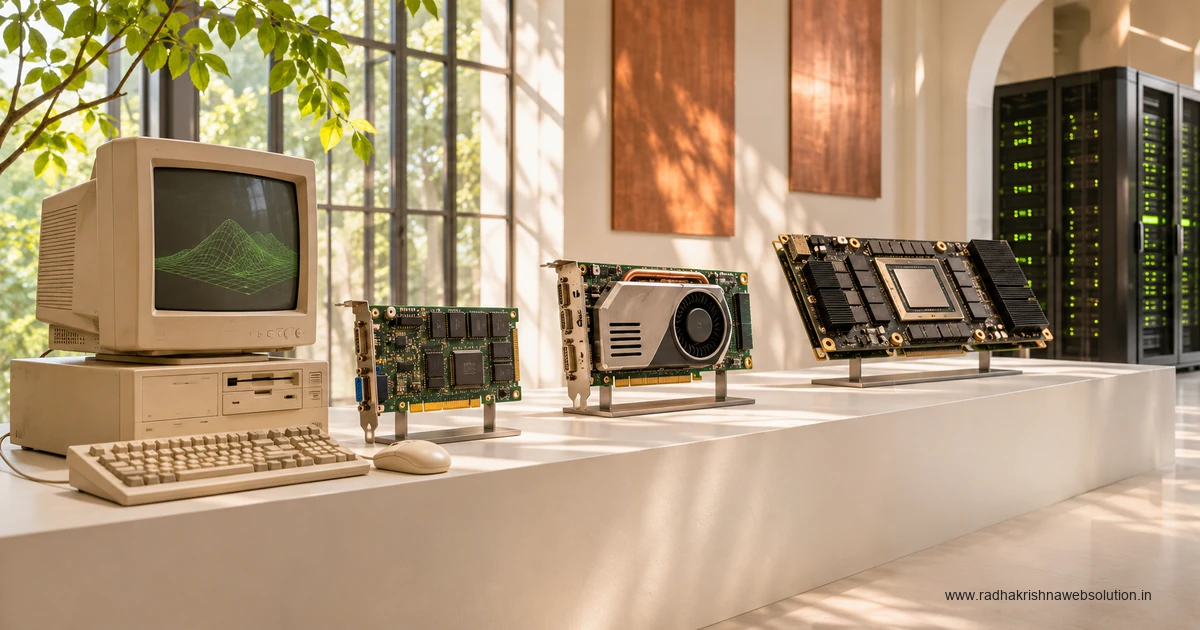
NVIDIA's story is not simply a successful graphics-card business that got lucky during the AI boom. It is a sequence of interconnected bets: graphics acceleration, programmable parallel processors, developer software, deep learning, high-speed interconnects and integrated AI systems. NVIDIA's own corporate innovation timeline identifies the crucial milestones. Understanding that history helps explain both the company's enduring strengths and the challenges following founder Jensen Huang's departure as CEO on 12 November 2026.
This article takes an engineering and business perspective rather than offering a celebrity biography. It traces what changed in the product, why developers adopted it, how the revenue model shifted and what alternatives might challenge NVIDIA's position.
1993: the founding vision
NVIDIA was founded on 5 April 1993 by Jensen Huang, Chris Malachowsky and Curtis Priem. The original focus was faster 3D graphics for gaming and multimedia. Graphics workloads are highly parallel: the same types of calculations must run across millions of pixels, vertices and textures. That made them fertile ground for processors designed to handle many operations simultaneously rather than only a few complex instructions.
The gaming market supplied a demanding feedback loop. New games pushed image quality and frame rates; GPU makers competed to build better chips, drivers, memory systems and programming interfaces. The challenge was not just fabricating silicon. It was creating a reliable platform developers could target year after year.
1999: GPUs become a computing category
NVIDIA dates its invention of the graphics processing unit (GPU) to 1999. Dedicated graphics processors handled workloads that would otherwise compete for time on the CPU. Over time, programmable shaders and expanding memory bandwidth increased their flexibility. A GPU could apply similar operations to many inputs in parallel, making the architecture interesting for scientific and numerical workloads as well as rendering.
That does not mean every task runs faster on a GPU. Branch-heavy logic, small jobs, data-transfer overhead and serial dependencies can favor the CPU. The long-term breakthrough was learning how to match the right work to massively parallel hardware.
2006: CUDA changes the developer equation
In 2006 NVIDIA unveiled CUDA, a parallel-computing platform and programming model that exposed GPU acceleration beyond graphics APIs. Researchers and software engineers could write computational kernels and use libraries to run demanding mathematics on supported NVIDIA hardware. NVIDIA's CUDA documentation describes the model and its long adoption across science and industry.
Why did this matter? Hardware becomes more valuable when developers can program it, test it, profile it and reuse mature tools. Compilers, numerical libraries, documentation and community examples reduced the cost of adopting GPUs. Later tools such as CUDA-X libraries, TensorRT and AI framework integrations helped developers move from experiments to repeatable production services.
For the architecture, trade-offs and alternative runtimes, see our detailed CUDA and NVIDIA software ecosystem guide.
2012: deep learning gains momentum
NVIDIA's official timeline highlights the 2012 AlexNet deep-learning breakthrough as a turning point for AI adoption. Training large neural networks involves matrix multiplication and other operations that can exploit GPU parallelism. As research groups and later technology companies expanded model size, accelerator demand increasingly moved beyond games and graphics.
This change had several reinforcing effects. Better frameworks made GPUs easier to use; higher demand encouraged investment in AI-focused chip features; larger clusters exposed networking and memory bottlenecks; and successful model applications encouraged more compute investment. NVIDIA's role expanded from an equipment supplier to a platform provider.
2018–2022: graphics innovation continues while AI expands
The company's 2018 RTX milestone brought real-time ray tracing into a mainstream graphics product family, while Omniverse became a platform for simulation and collaborative 3D workflows. These capabilities connect to today's physical AI: robots and autonomous machines often need simulated environments, realistic sensors, physics and synthetic training data before they encounter the real world.
NVIDIA did not abandon gaming, professional visualisation or scientific computing when AI demand grew. The markets share foundational investments in GPU processing, software tools and system integration, even though their performance goals differ.
2023–2026: from chips to whole AI factories
Modern AI deployments need far more than a fast accelerator card. Data centres require networking, racks, power, cooling, distributed training software, model-serving engines, storage and observability. NVIDIA increasingly sells and supports an integrated AI factory platform rather than only standalone GPUs.
Its recent architecture sequence includes Grace Blackwell, Blackwell-family systems and the Vera Rubin platform. NVIDIA said in 2026 that Vera Rubin was ramping into full production, pairing CPUs, GPUs, switching and accelerator-related infrastructure. The term AI factory reflects a production system generating model-training and inference outputs; it is a vendor's framing and should not substitute for measuring actual throughput, energy consumption and total cost.
Explore our Blackwell vs Vera Rubin explainer for the technical differences and NVIDIA's reported production status.
NVIDIA's timeline at a glance
| Year | Milestone | Strategic impact |
|---|---|---|
| 1993 | NVIDIA founded | Focus on faster 3D graphics |
| 1999 | GPU milestone | Parallel acceleration becomes a product category |
| 2006 | CUDA unveiled | Developers can program GPUs for general computing |
| 2012 | AlexNet deep-learning breakthrough | GPU computing scales into AI research |
| 2018 | RTX real-time ray tracing | Graphics and simulation capabilities deepen |
| 2022 | Omniverse milestone | Simulation platform supports digital-world workflows |
| 2026 | Vera Rubin production and AI-factory expansion | Rack-scale platform for training and inference |
What made NVIDIA difficult to compete with?
The hardware-plus-software feedback loop
NVIDIA benefits when software libraries are tuned for its devices, developers already know its tools, model vendors publish tested instructions, and cloud providers offer widely available compatible instances. Those advantages compound, but they are not permanent guarantees. A rival offering lower cost or better performance for a specific workload can gain share if customers can migrate software safely.
Networking and system engineering
Very large models require communication among accelerators. Interconnect design, scheduling and memory management may matter as much as the compute rate of a single chip. An entire system is only as useful as its slowest bottleneck, so procurement teams need end-to-end benchmarks.
Commercial reach and developer trust
Cloud partnerships, equipment makers, independent software vendors and an established programming ecosystem make NVIDIA easier to adopt. On the other hand, concentrated vendor dependence raises questions about price, supply, compliance and replacement options.
How competitors challenge NVIDIA
AMD offers Instinct accelerators and ROCm software; Google's TPUs serve many TensorFlow and PyTorch-based workloads; custom silicon and CPU-centric inference can be preferable for particular tasks. There is no credible universal winner for every model and deployment size. Compare latency, cost per useful output, model compatibility, availability, operational tooling and support contracts rather than picking hardware from benchmark headlines alone.
For examples outside NVIDIA, read RKWS's Vultr and AMD Chennai AI supercluster guide and our TorchTPU and PyTorch TPU ecosystem analysis.
What Jensen Huang's resignation changes—and what it does not
Huang was the company's founding CEO for roughly 33 years. His immediate resignation creates a major succession challenge, documented in our November 2026 leadership timeline. Yet the technology platform rests on years of engineering work and a global partner network. The future depends on whether NVIDIA can maintain product execution, developer confidence, clear governance and reliable commercial relationships.
For business readers, the larger lesson is that a sustainable technology advantage rarely comes from one invention. It comes from the ecosystem around it: tools, infrastructure, user adoption and continued iteration. Our NVIDIA financial and AI-infrastructure analysis shows how that ecosystem now appears in revenue and capital spending.
Sources and further reading
- NVIDIA corporate timeline
- NVIDIA CUDA FAQ
- Vera Rubin production announcement, 2026
- NVIDIA leadership transition, November 2026
Research reviewed 12 November 2026. Historical milestones are based on NVIDIA's published account; commercial implications are independent analysis, not guarantees of performance or market results.
Frequently asked questions
When was NVIDIA founded and by whom?
NVIDIA was founded on 5 April 1993 by Jensen Huang, Chris Malachowsky and Curtis Priem.
When did NVIDIA introduce the GPU?
NVIDIA dates its GPU milestone to 1999.
Why was CUDA important?
CUDA, unveiled in 2006, allowed general-purpose parallel computing using NVIDIA GPUs and helped build an extensive developer software ecosystem.
How did NVIDIA become central to AI?
Its GPUs accelerated deep learning, including the 2012 AlexNet breakthrough; NVIDIA then expanded from chips into systems, networking, libraries and cloud-scale AI platforms.