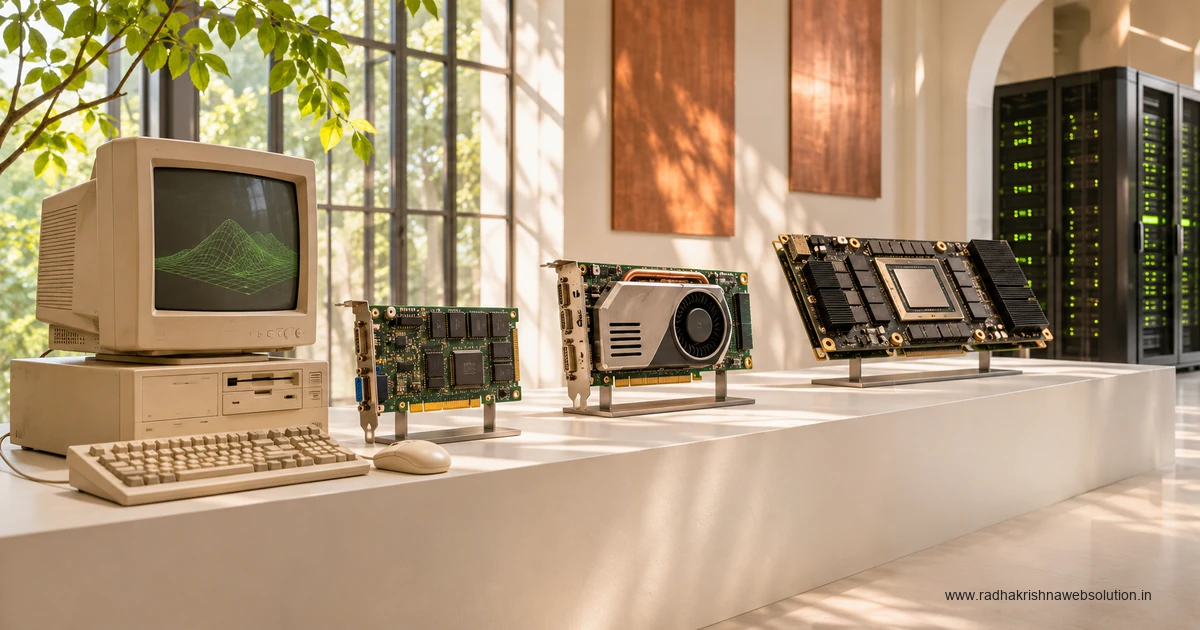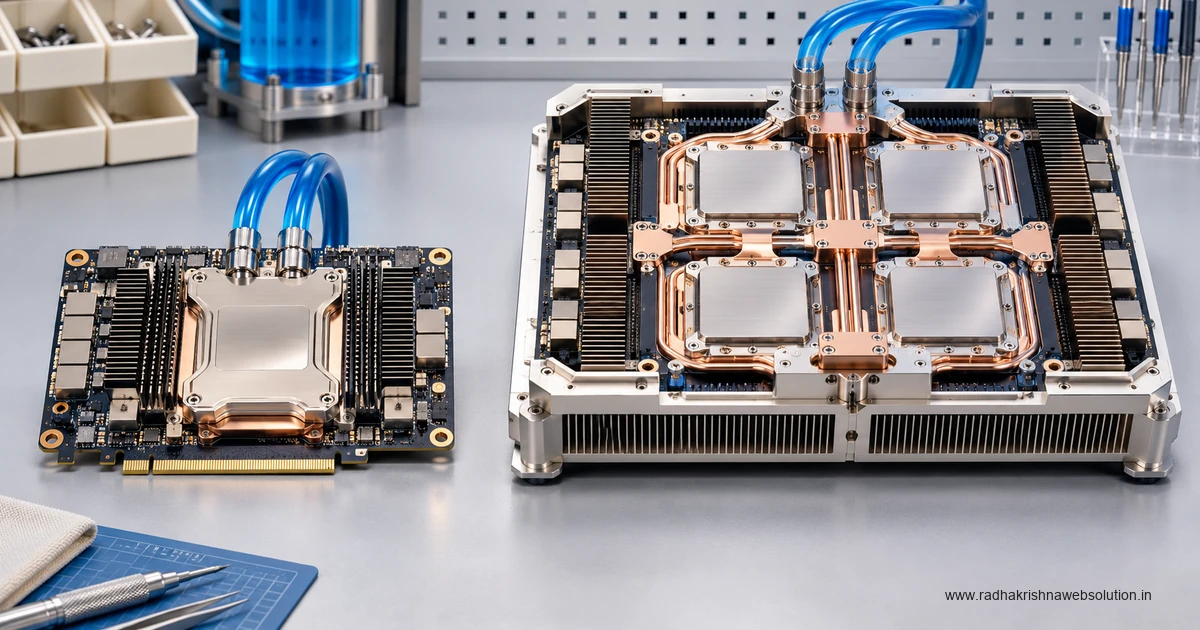
NVIDIA Blackwell and Vera Rubin represent successive stages of the company's AI computing strategy: build faster accelerators, but also reduce bottlenecks across CPU coordination, memory, networking, cooling and software. These platforms are not just gaming graphics cards repackaged for data centres. They are designed for increasingly demanding model training and inference workloads across many cooperating processors.
In 2026, NVIDIA has described its Vera Rubin platform as entering full production. That is a company-reported manufacturing milestone; it does not by itself prove that every cloud provider can immediately deliver unlimited capacity. Buyers should distinguish NVIDIA's platform announcements from shipment, installation, testing and generally available cloud services.
Primary sources include NVIDIA's Blackwell architecture information, data-centre platform documentation, and its 2026 Vera Rubin production announcement. Read the company's latest product sheets for exact model-specific capacities and configurations rather than treating a headline ratio as a universal benchmark.
What is NVIDIA Blackwell?
Blackwell is an NVIDIA GPU architecture aimed at accelerating AI training, inference and high-performance computation. Its data-centre products are commonly deployed as part of larger systems that also include CPUs, fast memory, interconnects and switching. The GB200 NVL72 rack-scale concept brought multiple Blackwell GPUs and Grace CPUs together with high-bandwidth GPU-to-GPU connectivity. The aim is to reduce the cost and time of moving data through demanding model workflows.
Blackwell-family deployments have multiple variants, so a comparison based on the word “Blackwell” alone is incomplete. Hardware versions, memory, power envelopes and network configurations vary. The right unit of analysis might be a single GPU, a server, a full rack or a cluster, depending on the application.
What is NVIDIA Vera Rubin?
Vera Rubin is the subsequent NVIDIA AI platform generation, organised around Vera CPUs, Rubin GPUs, networking and rack-scale systems. NVIDIA positions it as infrastructure for agentic AI, reasoning-heavy inference and demanding model-training jobs. In practice its effectiveness depends on software support and the availability of fully commissioned systems, not solely silicon specifications.
Vera Rubin is also part of NVIDIA's longer transition from selling a component to delivering an integrated AI-factory platform. To understand how that positioning emerged, read our NVIDIA history and GPU-to-AI evolution guide.
Blackwell versus Vera Rubin: practical comparison
| Dimension | Blackwell generation | Vera Rubin generation |
|---|---|---|
| Product role | Current established AI accelerator family | Subsequent AI platform generation |
| System orientation | GPU servers and integrated NVL systems | Newer rack-scale CPU/GPU/network integration |
| Typical use | Model training and inference | Training, reasoning and high-scale inference |
| Software consideration | Existing compatibility and optimisations | Validate application/library support and migration |
| Commercial consideration | Established deployment options, variable supply | Newer platform; confirm shipments and cloud readiness |
| Decision metric | Measured workload-level cost and throughput | Measured workload-level improvements after deployment |
Why does rack-scale design matter more than the GPU alone?
A large language model may be too big or too demanding for one accelerator. Workloads distribute across many chips, and each chip must exchange data with others. Even impressive per-GPU compute can be wasted if the memory system, networking or collective communication is slow. A rack-scale design integrates more of these elements and can simplify performance tuning, but it also increases operational complexity, cooling demands and procurement concentration.
Memory: model weights, caches and intermediate results must fit or be efficiently distributed. Interconnect: fast communication reduces time lost waiting for other accelerators. Networking: multi-rack training adds a second layer of communication. Software: frameworks must schedule work and overlap compute with transfer. Facilities: data centres need electrical capacity, cooling and serviceability.
Training versus inference: what should you benchmark?
Training benchmarks emphasise time to reach a target quality level, cluster efficiency, reliability during long jobs and the cost of failed or repeated experiments. Inference benchmarks emphasise throughput, first-token latency, completion latency, concurrency, cost per useful output and whether models satisfy quality and safety requirements. A model may run better on one platform during batch processing but poorly under interactive traffic.
For AI agents, the total response time also includes retrieval, tool calls, external APIs and application logic. Our AI agent observability guide explains how to measure the entire system rather than attributing every delay to the GPU.
CUDA, TensorRT and migration challenges
NVIDIA's CUDA software platform provides programming tools and libraries, while TensorRT and associated inference technologies help optimise supported model workloads. New hardware does not automatically deliver its advertised potential with old libraries or an unsupported model architecture. Developers should reproduce benchmarks with their chosen versions, precisions, batch sizes and actual prompts.
Read our detailed NVIDIA CUDA and inference software guide for compatibility questions and optimisation principles.
Power, cooling and total cost of ownership
Rack procurement is only one cost. Electricity, cooling, redundant networking, physical capacity, maintenance, storage, support contracts, utilisation and financing all affect the total cost. A nominally faster machine may be less economical if reserved capacity sits idle or if migration consumes months of engineering time.
Before purchasing, request transparent measurements covering tokens per second per dollar, job-completion cost, expected energy consumption, reliability under failure, model compatibility and deployment lead time. Assess whether an existing Blackwell system or a flexible cloud deployment offers a better business outcome than an immediate migration to a newer generation.
Does Jensen Huang's resignation change the roadmap?
NVIDIA's November 2026 leadership transition is significant, but the company has not announced cancellation of its AI platforms. Customers should monitor official roadmap guidance and delivery commitments rather than assuming either a collapse or perfect continuity. The risk is operational and commercial; real answers require evidence from suppliers and support teams.
NVIDIA versus AMD and custom AI chips
Competitor platforms differ in software compatibility, memory, interconnect, availability and cost. Our AMD Instinct supercluster analysis for Chennai is a useful local-market comparison, not an assertion that one chip maker always wins. The better comparison is an application-level benchmark performed under similar service conditions.
Procurement checklist for Indian businesses
- Identify whether you are training, fine-tuning or serving models.
- Quantify daily request traffic, latency goals and model memory needs.
- Compare cloud on-demand, reserved instances and on-premises alternatives.
- Confirm software, drivers, libraries and framework support.
- Test data-residency and export restrictions where applicable.
- Benchmark realistic workloads including concurrent users and failure recovery.
- Verify the provider's actual availability and support terms.
Further sources and related RKWS reading
- NVIDIA Blackwell architecture
- NVIDIA data centre portfolio
- NVIDIA AI-factory economics and earnings
- NVIDIA physical AI and robotics
Reviewed 12 November 2026. Product specifications and availability evolve; confirm hardware-specific information with current vendor documentation. This is independent technical analysis, not a vendor benchmark.
Frequently asked questions
Is Vera Rubin the successor to Blackwell?
Vera Rubin is NVIDIA's next AI platform generation after Blackwell, integrating CPUs, GPUs, networking and systems software.
Is Vera Rubin simply a faster GPU?
No. NVIDIA markets it as a full-scale AI computing platform including rack-level systems, connectivity and software.
Does NVIDIA's CEO transition cancel Vera Rubin?
NVIDIA did not announce a Vera Rubin cancellation when it confirmed Jensen Huang's resignation in November 2026.
Should every company buy the newest NVIDIA GPUs?
No. Compare workload performance, price, power, available cloud instances, software support and migration effort.