Leave and attendance automation gives a small business a consistent way to capture attendance, request leave, approve exceptions and prepare payroll inputs. Document the actual policy before choosing a tool. Assign an owner for corrections, protect employee information and review records before they affect pay.
Small factories, clinics, institutes and agencies in Pune and PCMC often manage attendance in registers and leave on WhatsApp chats, which makes payroll week stressful and error prone. If you have already read Google Sheets automation for small business and CRM automation for small businesses, applying the same thinking to HR will save your office manager many hours every month.
Why leave and attendance becomes messy as you grow
With ten people, you can remember who is on leave. With thirty people across shifts, sites and work-from-home days, memory fails. Common problems include leave requests lost in chat, wrong casual and sick leave balances, late-coming not recorded, overtime disputes, and salary cuts that upset staff because records are unclear. These issues grow during festival season, appraisal time and audit visits.
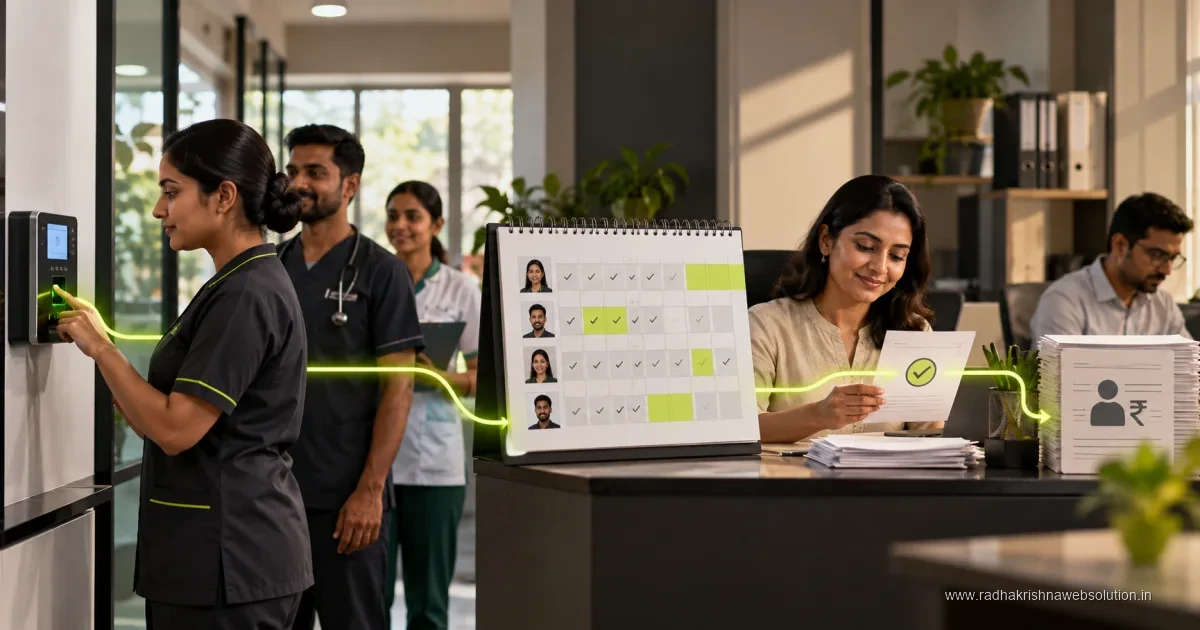
The fix is a single source of truth for attendance, leave and holidays that both staff and managers can see. When a helper in a Pimpri plant applies for leave on mobile, the supervisor approves in one tap, the balance updates instantly, and payroll gets the correct loss-of-pay days without retyping. Our automation services usually start with this simple visibility before adding biometric devices or payroll links.
- One mobile-friendly portal for attendance, leave, holidays and rosters.
- Clear leave types for casual, sick, earned, unpaid and compensatory off.
- Shift-wise late, early-going and overtime rules visible to all staff.
- Automatic leave balance update after approval, cancellation and sandwich rules.
- Monthly register that matches muster and wage needs for Indian compliance.
Design leave rules that suit Indian small teams
Keep rules simple enough to explain in one page in English, Hindi and Marathi. Define how many casual and sick leaves apply per year, whether they lapse or carry forward, notice period for planned leave, and how uninformed absence is treated. For shops and clinics in Vadodara and Pune with weekly offs on different days, set department-wise weekly holidays so rosters do not clash.
Handle special cases openly. Festival holidays differ by region, probation staff may have limited leave, and field staff may need half-day and short-leave options. Write sandwich rules clearly so staff know when weekly offs between leaves count as leave. When rules are transparent, approvals become faster and disputes come down.
- List leave types, yearly quota, carry-forward and encashment logic in plain words.
- Set approval chain for each team, with backup approver for supervisor leave.
- Define shift timings, grace period, half-day cut-off and overtime eligibility.
- Publish holiday list for Maharashtra and Gujarat sites at the start of the year.
- Review balances every quarter and share slips so staff can plan leaves.
Connect biometric, mobile and site attendance cleanly
Many SMBs use fingerprint or face devices at the main gate, plus mobile check-in for field and service teams. Sync device punches daily into the HR system and show missing punches to staff for regularisation. For sites without devices, use QR or location-based check-in with clear consent and working-hour limits, so tracking stays fair and limited to duty hours.
Under the DPDP Act, collect staff consent for biometric and location data, explain why it is needed for attendance and payroll, and limit access to HR and authorised managers. Retain logs only as long as needed for salary, audit and legal needs, then follow a clear retention policy. For current device and software pricing, check vendor pricing directly as models and plans change often. Good process matters more than costly hardware at this stage.
From attendance to payroll without retyping
Payroll errors mostly come from retyping attendance into salary sheets. A clean handover includes present days, paid leaves, unpaid leaves, overtime hours, late marks, incentives and deductions in one export. Your accountant or payroll partner should review exceptions before processing, not rebuild the sheet from chats and registers.
| Payroll input | Earlier manual habit | Automated handover |
|---|---|---|
| Present and absent days | Count from register and WhatsApp | System summary by employee and shift |
| Leave balance and LOP | Calculate on calculator near salary day | Auto LOP days with leave type breakup |
| Overtime and late marks | Settle verbally with supervisor | Approved overtime and late log for review |
| Final salary sheet | Retype into Excel for accountant | One payroll-ready export with exception notes |
What HR automation budgets look like in Rs for a 20 to 100 member team
For a small factory, clinic, or institute in Pune, PCMC, or Vadodara, the budget for leave and attendance automation depends mainly on sites, shifts, and devices already available. If you use mobile check-in and your existing registers are reasonably clean, the first phase is mostly about setting up masters, leave rules, holiday lists, and payroll-ready exports. If you need new biometric devices for two or three gates plus QR for field teams, allow more for hardware and installation. Keep the first scope to one location so you can compare old and new outputs for one salary cycle before expanding.
Plan for data cleanup as a separate line, not as an afterthought. Staff names, joining dates, shift mappings, and opening leave balances often need correction. Many managers find workflow automations that save hours weekly useful to see how small fixes compound over a month. For device pricing, check vendor sites directly, as plans change often. The real saving is fewer payroll corrections and disputes, which shows up quickly once balances are visible.
Mistakes that create staff resistance in Pune and Vadodara teams
The biggest mistake is announcing a new app without explaining the rules in simple language. Helpers, drivers, and field staff worry about salary cuts when they do not understand late marks, half-day cut-offs, and loss-of-pay logic. Share a one-page note in Marathi, Hindi, and English with examples, and hold a short demo in each shift. The second mistake is keeping approval chains too long. If every leave needs two or three approvals, requests pile up and staff return to WhatsApp. Keep one approver per team with a backup approver for supervisor leave.
The third mistake is ignoring consent and access control. Biometric and location data need clear staff consent and access limited to HR and authorised managers. Track location only during duty hours for field roles, and retain logs only as long as needed for salary and audit. The fourth mistake is changing rules mid-month without notice. Freeze rosters before payroll lock and announce changes for the next month.
How to measure ROI from leave and attendance automation
Measure three simple outcomes for the first two salary cycles. First, count payroll corrections and rework hours near salary day. If your accountant earlier spent two days reconciling registers and chats, note the reduced effort now. Second, track approval speed from leave application to decision, and the share of uninformed absences. Faster approvals and clearer balances usually reduce last-minute surprises. Third, track disputes about overtime, late marks, and leave encashment. Fewer escalations to the owner is a strong sign the system is trusted.
Connect attendance outputs cleanly to accounts so gains are not lost in retyping. A payroll-ready export with present days, paid and unpaid leaves, overtime, and exception notes should flow to your accountant without rebuilding sheets. If you use Tally, our guide on Tally integration automation in India shows how clean handover avoids duplication, and the note on invoice automation in India covers similar discipline for billing. Review these measures monthly with your HR SPOC.
Simple rollout plan for a 20 to 100 member team
Start with one location in Pune or PCMC for two to four weeks. Migrate staff list, shifts and opening leave balances, then run old and new methods in parallel for one salary cycle. Train supervisors on approvals and regularisation, and share a two-minute video in Marathi and Hindi for helpers and field staff who are less comfortable with apps.
Measure success by fewer payroll corrections, faster approvals and fewer disputes, not by complex reports. After one clean cycle, add the second branch or site, then connect payroll software. Keep an HR SPOC who owns masters, holiday updates and monthly lock so records stay reliable through audits.
Want disciplined rosters, mobile leave approvals and payroll-ready attendance for your clinic, plant or institute? Explore our automation services for HR and operations for a quick study of your shifts and registers.
Need leave, attendance and payroll inputs sorted for your small team in Pune, PCMC or Vadodara? Reach RadhaKrishna Web Solutions via our contact page or call +91 70962 91214 to plan a simple HR automation pilot.
Official references and further reading
Frequently asked questions
How long does it take to automate leave and attendance for a small team?
A single location with clear shifts can go live in two to four weeks, including master cleanup and one parallel salary cycle. Multi-branch rollouts take longer based on device and roster needs.
Do we still need biometric devices if staff use mobile check-in?
Many offices use devices at the main gate plus mobile check-in for field teams. Choose based on site reality, and keep consent and duty-hour limits clear for location tracking.
How should we handle staff data privacy for attendance records?
Take consent for biometric and location data, limit access to HR and managers, and keep logs only as long as needed for payroll and audit. Share a short policy with staff in local language.
What should we measure after automating attendance?
Track payroll corrections, approval speed, and dispute counts over two salary cycles. Fewer corrections and faster approvals show the system is working.