Most discussion of NVIDIA centres on language models and data-centre GPUs. Another important field is physical AI: artificial intelligence that must perceive, predict and act in the real world. This includes robots, industrial systems, autonomous equipment and simulated environments used to test machine behaviour before deployment.
For physical AI, powerful compute is necessary but not enough. A robot needs sensors, control algorithms, mechanical hardware, realistic training data and safety constraints. NVIDIA's software ecosystem—including Omniverse, the Isaac robotics tools and model-training infrastructure—aims to connect those pieces.
What is physical AI?
Physical AI describes systems whose outputs have consequences in a physical environment. A text assistant might produce an incorrect answer; a robot can collide with a person, damage equipment or mishandle fragile goods. Consequently, perception accuracy, control stability, safety testing and failure recovery matter alongside model intelligence.
Real-world use cases include warehouse picking, factory inspection, material handling, mobile robots and robotic manipulation. Some are already technically mature within narrow conditions; others remain research challenges. Marketing demonstrations should never be interpreted as proof of fully autonomous operation in arbitrary environments.
What is NVIDIA Omniverse?
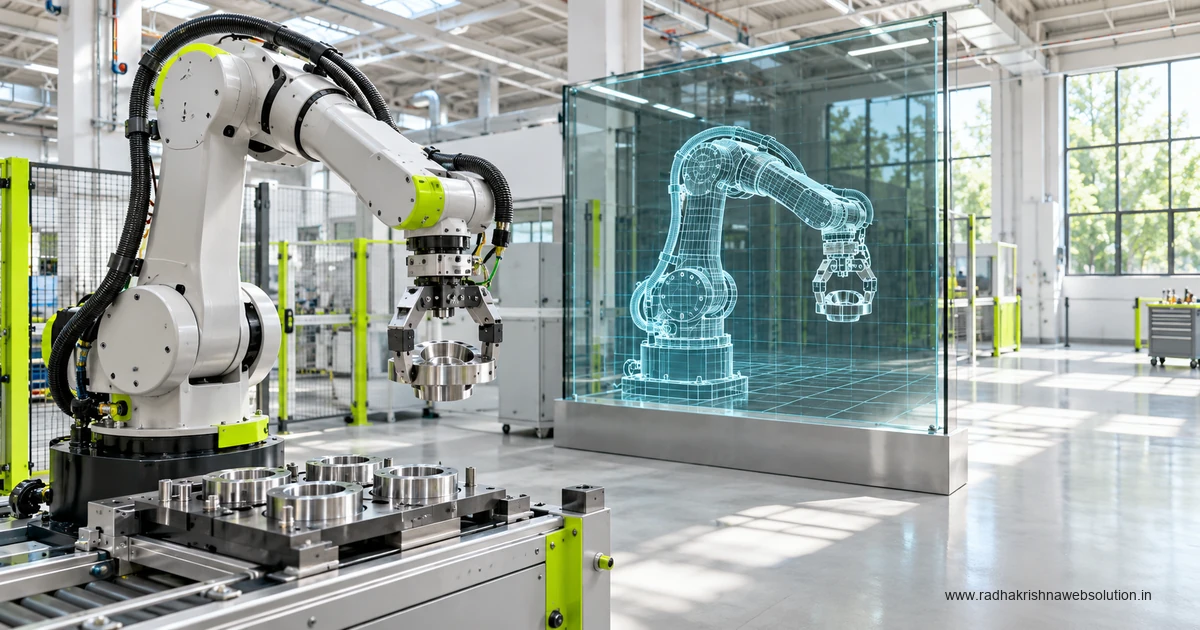
NVIDIA Omniverse is a collection of technologies for developing and operating physically based 3D simulation and digital-twin workflows. It can help teams represent a warehouse, manufacturing line or machine in a virtual environment and test aspects of their behaviour. Simulation may reduce the expense of repeated physical experiments and expose problems before on-site installation.
A digital twin is a digital representation of a physical system. Its usefulness depends on fidelity: geometry alone is not enough when friction, lighting, sensor noise, loads, timing and physical constraints affect real-world outcomes. A twin is only as trustworthy as its assumptions and validation evidence.
What is NVIDIA Isaac for robotics developers?
NVIDIA's Isaac robotics portfolio includes simulation, development and AI tools intended for robotics research and deployment. Developers use simulations to generate data, evaluate control policies and experiment with tasks without requiring a physical robot for every iteration.
This can support sim-to-real development: training or testing in a simulated world, then adapting and validating the behaviour on real hardware. However, simulation can miss unusual contacts, changing lighting, worn components and human behaviour. Every deployment needs physical trials and an appropriate safety case.
How do robot foundation models fit in?
Foundation-model research attempts to create reusable representations of objects, motion, commands and interactions that can transfer among tasks. This is more difficult than generating text because the robot must obey physics, detect physical state and act safely in real time. A model that understands a verbal command still needs accurate localisation, feasible manipulation and robust error handling.
When evaluating a robotics model, ask whether the reported result was measured in simulation, in a carefully controlled laboratory, or in a real customer environment. Also ask about the number of failures, recovery behaviour, human oversight and the types of objects the model has encountered.
Where GPUs and AI factories enter the picture
Robotics development can be compute-intensive. Training perception and control models, running numerous simulated environments and generating synthetic training data can all benefit from accelerated computing. That creates an architectural connection between NVIDIA's physical-AI software and its data-centre platforms.
Our Blackwell and Vera Rubin platform guide covers the compute infrastructure behind demanding AI workloads. Our CUDA developer ecosystem analysis explains why GPU software tools affect performance and developer productivity.
Simulation workflows: an example
Consider a warehouse wanting a robot to move packages from a conveyor into bins. A typical engineering workflow could be:
- Define the business requirement, object types, speed and safety constraints.
- Build a digital representation of the conveyor, bin area, robot and sensors.
- Collect physical measurements and calibration data.
- Train or tune vision, motion planning and manipulation components.
- Test in simulation against many package sizes, lighting scenarios and failure cases.
- Conduct controlled physical trials with human supervision.
- Record errors, revise the model and repeat tests.
- Deploy incrementally with emergency stops, monitoring and rollback procedures.
Simulation accelerates experimentation; it does not remove validation, operator training or workplace safety obligations. A real deployment also has maintenance, uptime and integration costs that a short technology demo may overlook.
What are the commercial opportunities?
Industrial simulation may help companies explore layout changes, identify bottlenecks and plan automation investment. Robotics can be valuable for repetitive, hazardous or high-precision processes where the economics are clear. The business case should compare existing manual or fixed-automation processes with the robot's total cost and measured service reliability.
Smaller companies may gain value first from software-based automation rather than humanoid robots. Our AI agent governance guide offers a framework for controlling digital agents, while agent monitoring practices can inform broader telemetry thinking. Physical systems, however, need additional specialised safety engineering.
Key risks: the simulation-to-reality gap
Models trained in a simplified simulation often struggle with surface friction, object deformation, unexpected obstructions, sensor drift or changes in human activity. Poorly measured environments can create an exaggerated impression of readiness. Developers mitigate the gap with varied training conditions, calibration, controlled real-world tests and conservative fail-safe behaviours.
Other risks include cyber-physical security, privacy implications of cameras, occupational safety, workforce training, hardware maintenance and integration with existing plant systems. These are distinct from the security controls required for ordinary text-generation agents.
What might the technology mean for India?
Indian manufacturers, logistics providers and engineering firms may benefit from simulation and robotics tools when they address a measurable operational problem. For example, a digital twin can help evaluate a production-layout change before purchasing new equipment, and a vision system can help inspect repetitive manufacturing tasks. Adoption should be guided by site-specific feasibility, skill availability and realistic return-on-investment calculations.
Infrastructure location and supply also matter. Our Chennai AI supercluster coverage illustrates how alternative GPU capacity could become useful to Indian AI teams, though it does not establish immediate robotics service availability.
Does NVIDIA's leadership transition change physical AI?
NVIDIA confirmed Jensen Huang's resignation on 12 November 2026 and stated its expectation of product-roadmap continuity. That statement does not independently prove every product will ship as planned. Industrial buyers should check long-term support, partner contracts and implementation capability rather than making decisions solely on leadership headlines. See the confirmed November leadership timeline.
Sources and related articles
- NVIDIA Omniverse
- NVIDIA Isaac robotics tools
- NVIDIA developer portal
- The history of NVIDIA's platforms
- The business of AI factories
Reviewed 12 November 2026. Product capabilities and research demonstrations are not presented as guarantees for a specific robot or factory.
Frequently asked questions
What is physical AI?
Physical AI refers to AI systems that perceive and act in the physical world, including robotics and autonomous machines.
What is NVIDIA Omniverse?
Omniverse is NVIDIA's platform and technology ecosystem for 3D simulation, physical-world modelling and digital-twin workflows.
What is NVIDIA Isaac?
Isaac refers to NVIDIA's robotics development tools, simulation technologies and related frameworks for training and deploying robot behaviours.
Does simulation guarantee a robot will work in a factory?
No. Simulation helps prepare and evaluate systems, but physical testing, safety engineering and site-specific validation remain essential.